
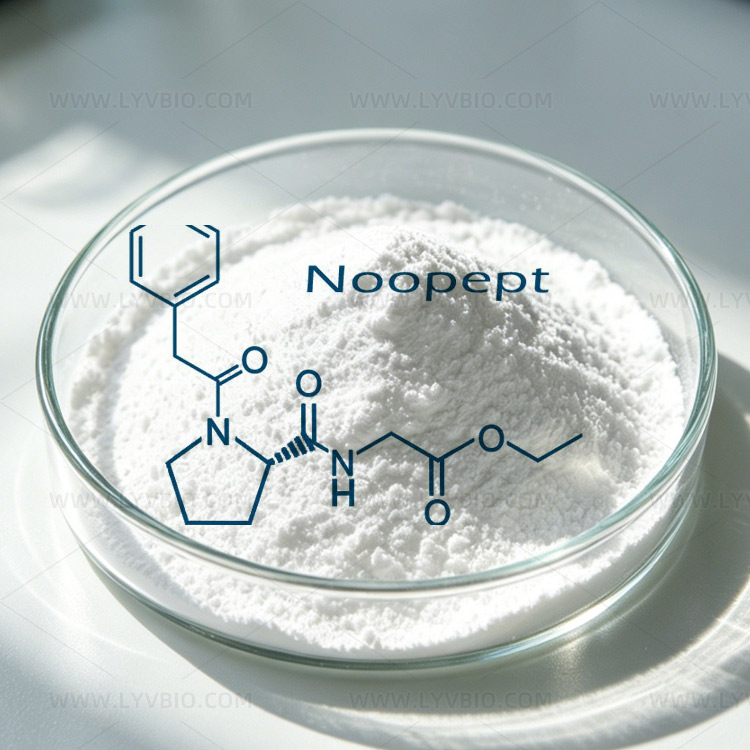
| Nom du produit | Noopept |
| Autres noms | GVS-111 ; ester éthylique de N-phénylacétyl-L-prolylglycine |
| Numéro CAS | 157115-85-0 |
| Formule moléculaire | C₁₇H₂₂N₂O₄ |
| Poids moléculaire | 334,37 g/mol |
| Apparence | Poudre cristalline blanche à blanc cassé |
| Essai (HPLC) | ≥ 99,01 TP3T |
| Point de fusion | 95–98 °C |
| Perte au séchage | ≤ 0,5% |
| Résidu au feu | ≤ 0,11 TP3T |
| Métaux lourds | ≤ 10 ppm |
Besoin d'aide ? Contacter notre équipe
Le Noopept (code de développement GVS-111) est un composé nootropique dipeptidique développé en Russie dans les années 1990 en tant que nouveau stimulant cognitif doté de propriétés neuroprotectrices. Sur le plan structurel, il s’agit d’un dérivé de la cycloprolyl-glycine qui présente certaines similitudes pharmacologiques avec les racétams (en particulier le piracétam), mais dont la puissance est nettement supérieure — estimée à environ 1 000 fois plus puissant que le piracétam.
Légende : Contrairement à la plupart des nootropiques, dont les effets ne se manifestent qu'au bout de plusieurs semaines, le Noopept a démontré une action rapide dans les modèles de recherche. Il présente à la fois améliorant les fonctions cognitives et neuroprotecteur propriétés, notamment une protection contre le stress oxydatif, l'excitotoxicité et les lésions d'ischémie-reperfusion. Le Noopept augmente également les taux de facteur neurotrophique dérivé du cerveau (BDNF) et de facteur de croissance nerveuse (NGF) dans l'hippocampe.
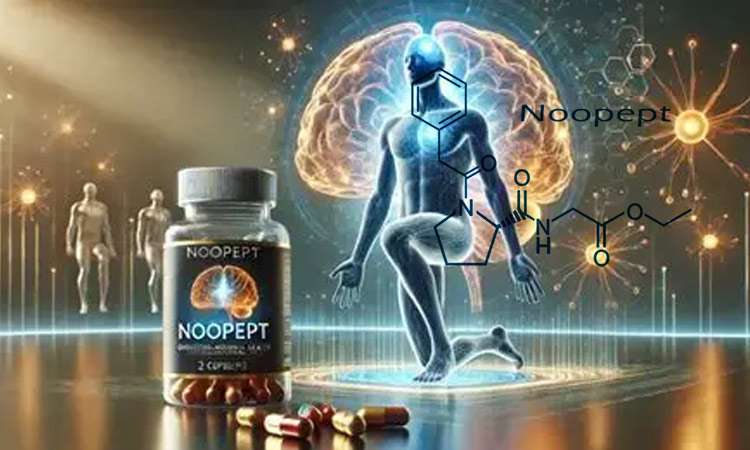
Le Noopept exerce ses effets par le biais de multiples voies, ce qui le distingue des racétams classiques :
| Parcours | Mécanisme | Résultats de la recherche |
|---|---|---|
| Surexpression du BDNF/NGF | Augmente les taux de facteur neurotrophique dérivé du cerveau et de facteur de croissance nerveuse dans l'hippocampe | Favorise la plasticité synaptique et la neurogenèse |
| Modulation des récepteurs AMPA/kaïnate | Modulation allostérique positive (similaire à celle des racétams) | Améliore la transmission glutamatergique |
| Neuroprotection | Réduit le stress oxydatif, inhibe la peroxydation lipidique, protège contre l'excitotoxicité | Modèles précliniques d'ischémie et de traumatisme crânien |
| Système cholinergique | Peut favoriser la libération d'acétylcholine (de manière indirecte) | Aide à la mémoire et à l'apprentissage |
| Anti-inflammatoire | Réduit la neuroinflammation (phase préclinique) | Neuroprotection |
Il a été démontré que le Noopept protège contre la neurodégénérescence dans des modèles animaux de la maladie d'Alzheimer, de la maladie de Parkinson et de l'ischémie cérébrale. Il réduit la toxicité de l'amyloïde-β et pourrait avoir un effet modificateur de la maladie (en phase préclinique uniquement).
LyvBio Co. est un fournisseur certifié GMP de Noopept (GVS-111) de haute pureté destiné à des applications de recherche et développement.
Capacités d'approvisionnement :
Dosage (HPLC) : ≥99,01 TP3T
Forme : Poudre cristalline
Capacité mensuelle : plus de 20 kg
Quantités en vrac : 1 g – 10 kg
Délai d'exécution : 3-5 jours (échantillons), 10-15 jours (vrac)
Documentation : COA, FDS, RMN-H, chromatogramme HPLC, données de stabilité
L'assurance qualité :
Pureté déterminée par HPLC avec détection UV
Solvants résiduels testés (conforme à la norme USP )
Métaux lourds analysés (ICP-MS)
Confirmation de la structure (RMN sur demande)
📧 Demandes de renseignements : info@lyvbio.com
| Paramètre | Spécifications | Méthode d'essai |
|---|---|---|
| Essai (HPLC) | ≥ 99,01 TP3T | HPLC-UV (210 nm) |
| Apparence | Poudre cristalline blanche à blanc cassé | Visuel |
| Identification | Temps de rétention par HPLC, RMN (sur demande) | HPLC / RMN |
| Point de fusion | 95–98 °C | USP |
| Perte au séchage | ≤ 0,5% | USP |
| Résidu au feu | ≤ 0,11 TP3T | USP |
| Métaux lourds | Pb ≤ 10 ppm ; As ≤ 2 ppm ; Cd ≤ 1 ppm ; Hg ≤ 0,1 ppm | ICP-MS |
| Substances apparentées | Impureté unique ≤ 0,51 TP3T ; Total ≤ 1,01 TP3T | HPLC-UV |
| Solvants résiduels | Découvrez la norme USP | GC |
| Granulométrie | 95% jusqu'au tamis de 80 mesh | Analyse granulométrique |
Q : Le Noopept, c'est la même chose que le piracétam ?
R : Non. Le Noopept est un dérivé de dipeptide présentant une structure chimique différente, une puissance nettement supérieure (~1 000 fois) et des mécanismes d'action distincts (notamment la régulation à la hausse du BDNF et du NGF). Il ne s'agit pas d'un racétam, bien qu'il partage certaines similitudes pharmacologiques avec cette classe de composés.
Q : Le Noopept est-il autorisé par la FDA ?
R : Non. Le Noopept n'est pas autorisé par la FDA pour un usage médical aux États-Unis. Il est disponible en tant que produit chimique de recherche destiné exclusivement à un usage en laboratoire. Il a été utilisé comme médicament sur ordonnance en Russie.
Q : Quelle est la différence entre le Noopept et les autres nootropiques ?
R : Le Noopept se distingue par sa capacité à stimuler la production de BDNF et de NGF dans l'hippocampe, une propriété que ne possèdent pas les racétams classiques. Il est également nettement plus puissant (dosage en microgrammes contre milligrammes).
Q : Quel est le principal métabolite actif du Noopept ?
R : La cycloprolylglycine (CPG). Le Noopept est rapidement métabolisé en CPG, qui contribuerait de manière significative à ses effets pharmacologiques.
Q : Le Noopept possède-t-il des propriétés neuroprotectrices ?
R : Oui. Des études précliniques ont mis en évidence des effets neuroprotecteurs dans des modèles d'AVC, de traumatisme crânien, d'excitotoxicité et de neurodégénérescence (modèles de la maladie d'Alzheimer et de la maladie de Parkinson).
Q : Quelle est la fourchette de doses efficaces observée dans les études sur les animaux ?
R : Des études publiées font état d'effets améliorant les fonctions cognitives et neuroprotecteurs à des doses comprises entre 0,1 et 1 mg/kg (par voie orale) chez les rongeurs, soit une puissance environ 1 000 fois supérieure à celle du piracétam.
Q : Existe-t-il des essais cliniques chez l'homme concernant le Noopept ?
R : Des études cliniques limitées ont été menées en Russie, où le Noopept est autorisé en tant que nootropique délivré sur ordonnance.
Demandes de renseignements : info@lyvbio.com
 English English
  Russian
 French
 Korean
 German
 Polish
 Japanese
 Spanish
 Italian
 Vietnamese