
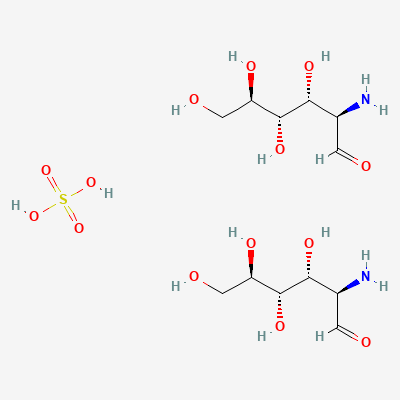
Glucosamine Sulfate
| Tên sản phẩm | Glucosamine Sulfate |
|---|---|
| Số CAS | 29031-19-4 |
| Hình thức | Bột tinh thể màu trắng đến trắng ngà |
| Thông số kỹ thuật | ≥99% (HPLC) |
| Công thức phân tử | C6H13NO5·H2SO4 |
| Trọng lượng phân tử | 277.25 g/mol |
| Độ hòa tan | Soluble in water, slightly soluble in ethanol |
| Gói | 25 kg fiber drum with double polyethylene liner |
Cần trợ giúp? Liên hệ với đội ngũ của chúng tôi
Từ đồng nghĩa: Glucosamine sulfate, D-Glucosamine sulfate, 2-Amino-2-deoxy-D-glucose sulfate, Chitosamine sulfate, Glucosamine sulfuric acid ester
Glucosamine sulfate is the sulfate ester of glucosamine, an amino sugar that occurs naturally in the human body and in the exoskeletons of crustaceans. It is a fundamental building block for glycosaminoglycans, the large molecules that give cartilage its resilience and shock-absorbing properties. In supplement and pharmaceutical applications, it is typically stabilized as a salt—most commonly the potassium or sodium chloride complex—to improve shelf life and bioavailability.
Unlike glucosamine hydrochloride, the sulfate form delivers both glucosamine and sulfate ions, which are directly involved in the synthesis of proteoglycans. This distinction has made it a preferred raw material for joint-health formulations, particularly in Europe where it is often used at higher clinical doses. The sulfate moiety also enhances solubility, facilitating incorporation into liquid and powder blends.
Commercial glucosamine sulfate is produced by hydrolyzing chitin from shellfish shells, followed by sulfation and purification. The resulting material is standardized to a consistent assay, typically ≥99% on a dried basis, and is available in several salt forms to suit different formulation needs. Its well-characterized safety profile and long history of use make it a reliable choice for dietary supplements and pharmaceutical preparations targeting joint and cartilage support.
| Tham số | Thông số kỹ thuật |
|---|---|
| Phương pháp phân tích (HPLC) | ≥99.0% |
| Xác định | Phổ hồng ngoại phù hợp với phổ tham chiếu |
| Mất mát khi sấy khô | ≤0.5% |
| Hàm lượng tro sau khi đốt | ≤0.1% |
| Kim loại nặng | ≤10 ppm |
| Giới hạn vi sinh vật | Total aerobic count ≤1000 CFU/g; Yeast & Mold ≤100 CFU/g; E. coli absent |
Room,5-0203, Unit 5, Beiyuanmen Street,Xi'an,Shaanxi,China
 English English
 Russian
 French
 Korean
 German
 Polish
 Japanese
 Spanish
 Italian
 Vietnamese