
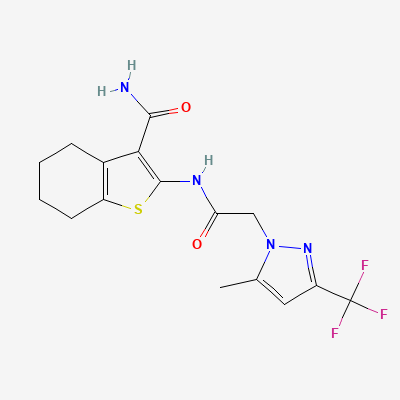
YDL223C
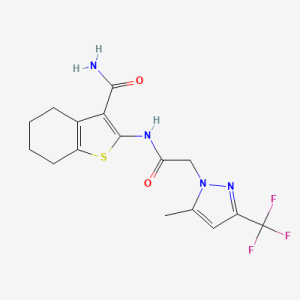
| Nazwa produktu | YDL223C |
|---|---|
| Numer CAS | 489408-02-8 |
| Synonyms | YDL-223C; YDL 223C |
| Wygląd | Biały lub prawie biały krystaliczny proszek |
| Czystość (HPLC) | ≥98,01 TP3T |
| Wzór cząsteczkowy | C17H19F3N2O2 |
| Masa cząsteczkowa | 340.34 g/mol |
| Rozpuszczalność | Soluble in DMSO, ethanol; slightly soluble in water |
| Przechowywanie | Store at -20°C, protected from light and moisture |
| Opakowanie | 10 mg, 50 mg, 100 mg, 500 mg, 1 g (bulk available) |
Potrzebujesz pomocy? Skontaktuj się z naszym zespołem
Synonyms: YDL-223C, YDL 223C
YDL223C is a synthetic small-molecule compound that has drawn interest in medicinal chemistry and early-stage drug discovery, particularly as a tool for probing protein–protein interactions and cellular signaling pathways. While its exact target profile remains under investigation, the compound’s trifluoromethyl-substituted aryl scaffold and imidazolidinedione core place it within a well-explored chemical space known for metabolic stability and membrane permeability. Researchers frequently employ YDL223C as a reference standard or screening hit in assay development, where reproducible purity and consistent solid-state form are critical.
From a structural standpoint, YDL223C features a 4-(4,4-dimethyl-2,5-dioxoimidazolidin-1-yl)-2-(trifluoromethyl)benzonitrile motif—a combination that balances lipophilic and polar character. The nitrile group offers a handle for further derivatization, while the gem-dimethyl imidazolidinedione contributes to conformational rigidity. This architecture is reminiscent of non-steroidal ligands designed to engage hydrophobic pockets, making the compound a useful probe in receptor-binding studies and structure–activity relationship (SAR) campaigns.
In the broader context of chemical biology, YDL223C is typically supplied as a high-purity solid (≥98% by HPLC) to support in vitro and cell-based experiments. Its solubility in DMSO and ethanol allows straightforward preparation of stock solutions, and the compound is stable under recommended storage conditions. While not yet a commercial therapeutic, it represents a valuable research tool for teams exploring novel mechanisms in oncology, inflammation, or metabolic disease.
| Parametr | Specyfikacja |
|---|---|
| Oznaczenie (HPLC) | ≥98,01 TP3T |
| Identyfikacja | NMR, MS conform to structure |
| Strata przy suszeniu | ≤0.5% |
| Popiół po spaleniu | ≤0,11 TP3T |
| Metale ciężkie | ≤10 ppm |
| Wartości graniczne dla mikroorganizmów | Total aerobic count ≤1000 CFU/g; Yeast & Mold ≤100 CFU/g |
Room,5-0203, Unit 5, Beiyuanmen Street,Xi'an,Shaanxi,China
 English English
 Russian
 French
 Korean
 German
 Polish
 Japanese
 Spanish
 Italian
 Vietnamese