
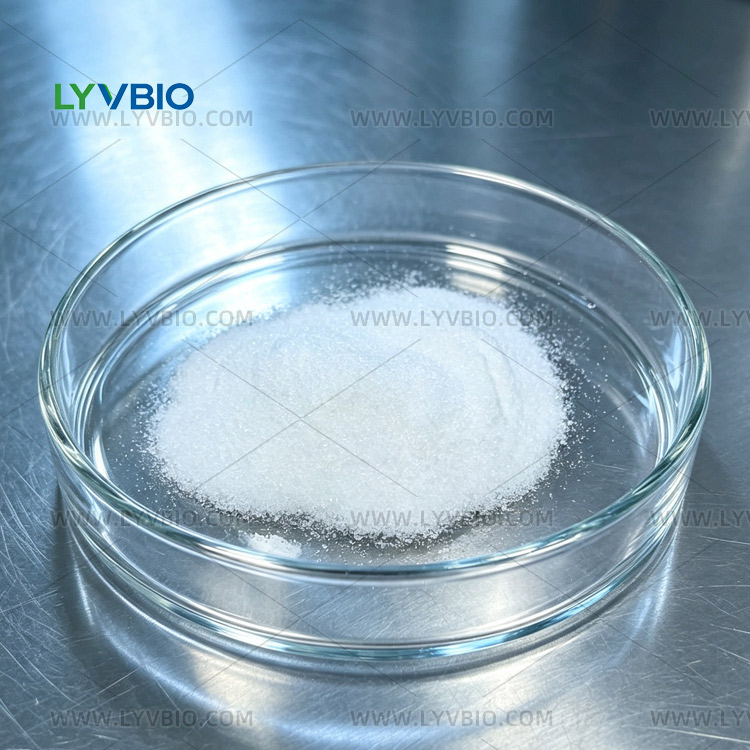
| Nom du produit | Acide pentadécanoïque |
|---|---|
| Numéro CAS | 1002-84-2 |
| Formule moléculaire | C₁₅H₃₀O₂ |
| Poids moléculaire | 242.40 g/mol |
| Apparence | Poudre cristalline blanche à blanc cassé |
| Assay (GC) | ≥ 98.0% |
| Point de fusion | 51 – 53°C |
| Boiling Point | 257°C (lit.) |
| Perte au séchage | ≤ 0,5% |
| Résidu au feu | ≤ 0,11 TP3T |
| Métaux lourds | ≤ 10 ppm |
| Stockage | Store in a cool, dry place, protected from light and moisture |
| Solubilité | Soluble in chloroform, ethanol, oils; insoluble in water |
Besoin d'aide ? Contacter notre équipe
Synonymes : Pentadecanoic Acid, Pentadecylic Acid, C15:0 Fatty Acid, n-Pentadecanoic Acid, Pentadecanoic Acid (C15:0), Hexadecanoic Acid Impurity, Odd‑Chain Fatty Acid
Pentadecanoic Acid is a saturated straight‑chain fatty acid with 15 carbon atoms (C15:0). It is a naturally occurring odd‑chain fatty acid found in small quantities in dairy fat, certain fish oils, and some plant oils. Unlike even‑chain fatty acids (e.g., palmitic acid C16:0, stearic acid C18:0), pentadecanoic acid is relatively rare in nature and has attracted interest for its potential health benefits.
Pentadecanoic acid has been studied for its role as a biomarker of dairy fat intake and its potential association with reduced risk of cardiovascular disease, type 2 diabetes, and inflammation.
It is also used as an internal standard in fatty acid analysis and as a reference compound for lipid research.
Research application: Used as an internal standard for fatty acid analysis (GC).
Health biomarker: Indicator of dietary fat intake, particularly dairy fat.
Santé cardiovasculaire: Associated with favorable lipid profiles in epidemiological studies.
Anti‑inflammatory support: May modulate inflammatory pathways.
Skin barrier support: Potential role in maintaining skin barrier function.
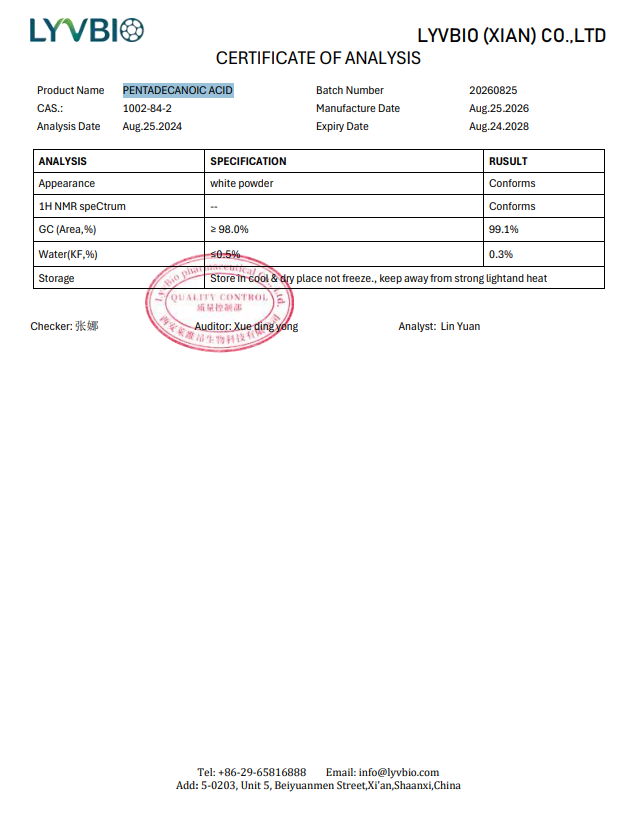
Source: Synthetic
Normalisation: ≥98.0% pentadecanoic acid (GC)
Formulaires: Poudre cristalline blanche à blanc cassé
Applications: Analytical standards, lipid research, nutritional studies
Q: What is the significance of pentadecanoic acid as a biomarker?
A: Pentadecanoic acid is a reliable biomarker for dairy fat intake, as it is present in significant amounts in milk, cheese, and butter. Its levels in blood are correlated with dairy consumption.
Q: Is pentadecanoic acid essential?
A: Pentadecanoic acid is not classified as an essential fatty acid, but it may have health benefits, including associations with reduced inflammation and improved lipid profiles.
Q: What purity grades are available?
A: We supply pentadecanoic acid with ≥98.0% purity (GC).
Q: How is pentadecanoic acid analyzed?
A: Pentadecanoic acid is typically analyzed by GC‑FID or GC‑MS, often as a fatty acid methyl ester (FAME) derivative.
Q: Is pentadecanoic acid stable at room temperature?
A: Yes, pentadecanoic acid is stable at room temperature when stored in a sealed container, protected from light and moisture. Long‑term storage is recommended at 2–8°C.
© 2026 LyvBio Co., Ltd. | 280 Main Street, Xian, Shaanxi, China | Email: info@lyvbio.com
 English English
  Russian
 French
 Korean
 German
 Polish
 Japanese
 Spanish
 Italian
 Vietnamese