
Mitoquinone Bromide
| Nom du produit | Mitoquinone Bromide |
|---|---|
| Numéro CAS | 336184-91-9 |
| Formule moléculaire | C37H44BrO4P |
| Poids moléculaire | 663.63 g/mol |
| Apparence | Orange to dark red crystalline powder |
| Essai (HPLC) | ≥98,01 TP3T |
| Solubilité | Soluble in DMSO, ethanol, methanol; sparingly soluble in water |
| Stockage | Store at -20°C, protect from light and moisture |
| Colis | 10 mg, 50 mg, 100 mg, 500 mg, 1 g in amber glass vials |
Besoin d'aide ? Contacter notre équipe
Synonymes : Mitoquinone bromide, MitoQ, Mitoquinol mesylate, 10-(4,5-Dimethoxy-2-methyl-3,6-dioxo-1,4-cyclohexadien-1-yl)decyl triphenylphosphonium bromide, Ubiquinone-10 derivative
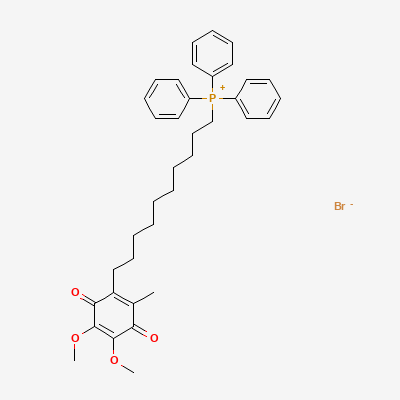
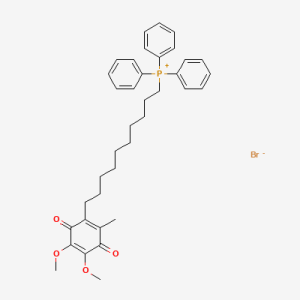
Mitoquinone bromide is a synthetic analog of coenzyme Q10 (ubiquinone) engineered to accumulate within mitochondria. Its structure features a triphenylphosphonium (TPP+) cation conjugated to a ubiquinone-like redox-active headgroup via a ten-carbon aliphatic linker. This design exploits the large mitochondrial membrane potential to drive selective uptake into the organelle, where the quinone moiety undergoes reversible reduction to a quinol, effectively scavenging reactive oxygen species (ROS) at the source.
Unlike natural ubiquinone, which distributes broadly across cellular membranes, mitoquinone bromide concentrates several-hundred-fold inside mitochondria. This targeted delivery makes it a valuable tool for studying mitochondrial oxidative stress in models of neurodegeneration, ischemia-reperfusion injury, and metabolic disorders. The bromide salt form enhances crystallinity and stability, facilitating accurate weighing and reproducible formulation in preclinical research.
As a research-grade compound, mitoquinone bromide is primarily supplied to pharmaceutical and biotechnology companies for drug discovery, mechanistic studies, and as a reference standard. Its well-characterized pharmacokinetics and safety profile in animal models have also spurred interest in developing mitochondria-targeted therapeutics, with several clinical trials exploring its potential in Parkinson’s disease and other age-related conditions.
Mitoquinone bromide consists of a redox-active 2,3-dimethoxy-5-methyl-1,4-benzoquinone core linked to a decyl chain terminating in a triphenylphosphonium group. The TPP+ cation confers lipophilicity and a delocalized positive charge, enabling rapid passage through lipid bilayers and electrophoretic accumulation in mitochondria. The compound is a orange to dark red crystalline solid, stable under recommended storage conditions, and exhibits strong UV absorbance around 270 nm. Its solubility profile supports dissolution in organic solvents for stock preparation, while aqueous formulations can be achieved with appropriate co-solvents.
| Paramètre | Spécifications |
|---|---|
| Apparence | Orange to dark red crystalline powder |
| Essai (HPLC) | ≥98,01 TP3T |
| Identification | Conforms to structure (NMR, MS) |
| Perte au séchage | ≤ 1,01 TP3T |
| Métaux lourds | ≤ 10 ppm |
| Solvants résiduels | Meets ICH Q3C guidelines |
Room,5-0203, Unit 5, Beiyuanmen Street,Xi'an,Shaanxi,China
 English English
 Russian
 French
 Korean
 German
 Polish
 Japanese
 Spanish
 Italian
 Vietnamese