
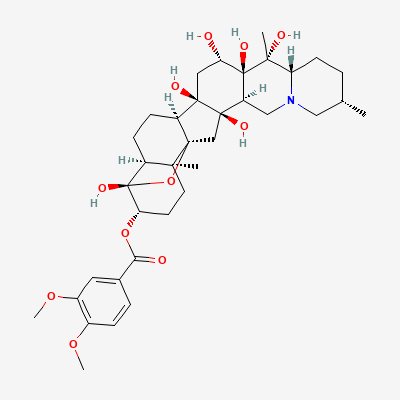
Veratridine
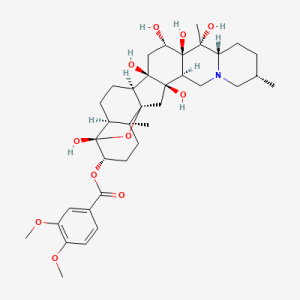
| Parámetro | Especificaciones |
|---|---|
| Nombre del producto | Veratridine |
| Número CAS | 71-62-5 |
| Fórmula molecular | C36H51NO11 |
| Peso molecular | 673.79 g/mol |
| Apariencia | Polvo cristalino de color blanco a blanquecino |
| Ensayo (HPLC) | ≥98,01 TP3T |
| Solubilidad | Soluble in ethanol, DMSO, methanol; slightly soluble in water |
| Paquete | 10 mg, 50 mg, 100 mg, 1 g |
¿Necesitas ayuda? Póngase en contacto con nuestro equipo
Sinónimos: 3-Veratroylveracevine, Veratridine, (3β,4α,16β)-4,9-Epoxycevane-3,4,12,14,16,17,20-heptol 3-(3,4-dimethoxybenzoate), Cevane-3,4,12,14,16,17,20-heptol 3-(3,4-dimethoxybenzoate)
Veratridine is a steroidal alkaloid derived from the cevane skeleton, featuring a 3,4-dimethoxybenzoyl ester at the C3 position. This lipophilic moiety enhances its interaction with voltage-gated sodium channels, making it a valuable tool in neuropharmacology. The compound is isolated from plants of the genus Veratrum, such as Veratrum album y Veratrum viride, and is known for its potent effects on ion channel dynamics.
As a research-grade chemical, Veratridine is typically available at ≥98% purity (HPLC). It is widely used in electrophysiology and cell-based assays to study sodium channel function, neurotoxicity, and cardiac arrhythmias. Its ability to lock sodium channels in the open state provides a unique mechanism for investigating excitability and signal transduction.
Beyond basic research, Veratridine serves as a reference standard in analytical method development and as a precursor in the synthesis of derivatives for drug discovery. Its commercial relevance spans pharmaceutical R&D, toxicology, and biochemical reagent supply.
Veratridine belongs to the veratrum alkaloids, characterized by a complex polycyclic cevane framework with multiple hydroxyl groups. The molecule’s amphiphilic nature—combining a polar polyhydroxy core with a nonpolar aromatic ester—facilitates membrane permeability and receptor binding. It is stable under recommended storage conditions but should be protected from light and moisture to prevent hydrolysis of the ester bond.
| Test Item | Especificaciones |
|---|---|
| Identificación | NMR, MS conform to structure |
| Pérdida por secado | ≤2.0% |
| Residuo tras la combustión | ≤0,51 TP3T |
| Metales pesados | ≤10 ppm |
| Límites microbianos | Total aerobic count ≤1000 CFU/g; Yeast & Mold ≤100 CFU/g |
| Sustancias relacionadas | Total impurities ≤2.0% |
Our standard MOQ is 10 mg. Larger quantities can be accommodated for bulk orders.
For stock items, delivery is typically 3-5 business days from order confirmation.
Yes, a COA is included with every shipment. Samples (typically 10-20 mg) are available for evaluation upon request.
send us your specification for a quotation.
Room,5-0203, Unit 5, Beiyuanmen Street,Xi'an,Shaanxi,China
 English English
 Russian
 French
 Korean
 German
 Polish
 Japanese
 Spanish
 Italian
 Vietnamese