
| Nombre del producto | Quercetina |
|---|---|
| Número CAS | 117-39-5 |
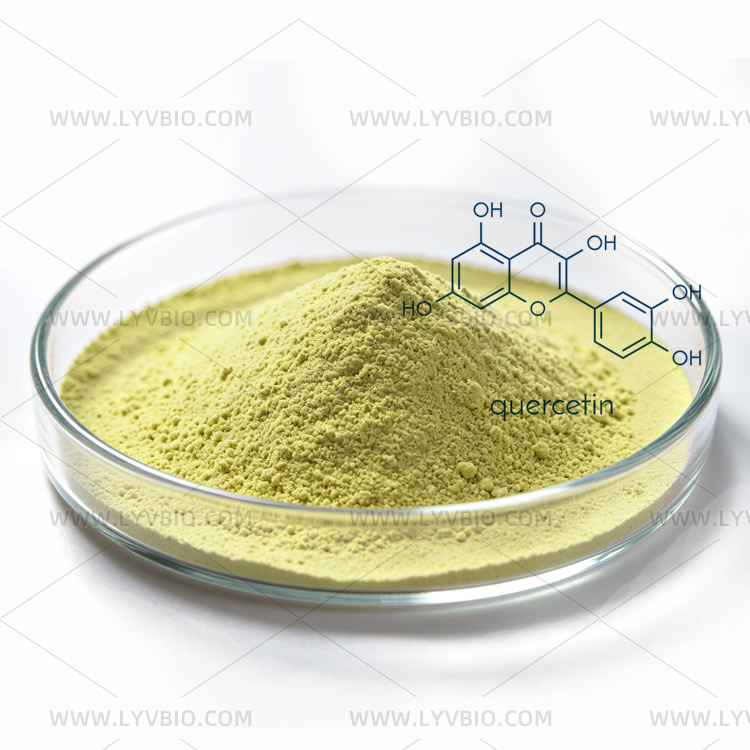
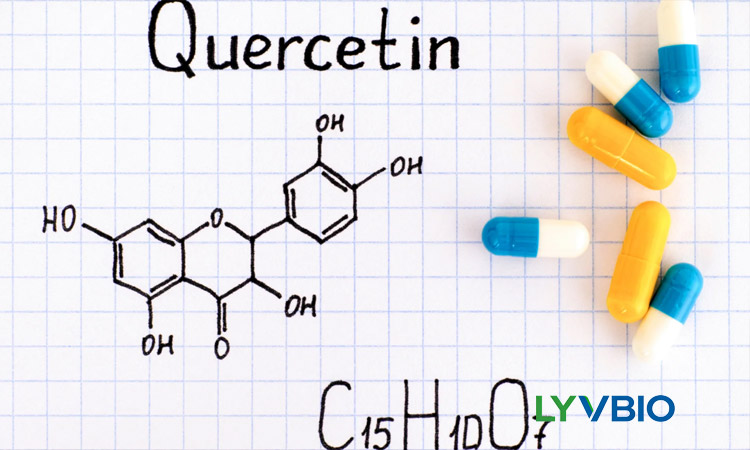
| Fórmula molecular | C₁₅H₁₀O₇ |
| Peso molecular | 302.24 g/mol |
| Apariencia | Yellow to greenish-yellow fine powder |
| Ensayo (HPLC) | ≥ 98,01 TP3T |
| Pérdida por secado | ≤ 1,01 TP3T |
| Residuo tras la combustión | ≤ 0,51 TP3T |
| Metales pesados | ≤ 10 ppm |
¿Necesitas ayuda? Póngase en contacto con nuestro equipo
Quercetin (3,3′,4′,5,7-pentahydroxyflavone) is a naturally occurring flavonoid belonging to the flavonol subclass.
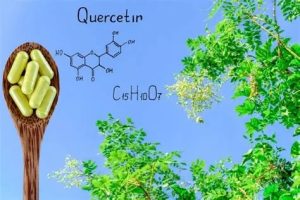
It is one of the most abundant and widely distributed dietary flavonoids, found in a variety of plant sources including onions, apples, berries, citrus fruits, buckwheat, and green tea.
It is also present in significant quantities in Sophora japonica (Japanese pagoda tree) and Ginkgo biloba, which are common commercial sources for extract standardization.
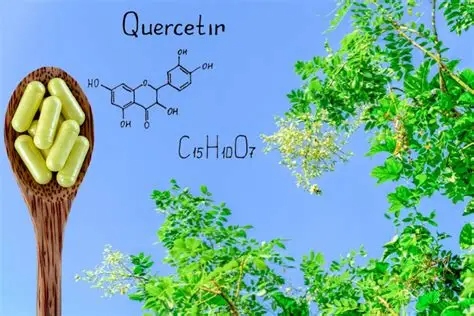
Quercetin is characterized by its potent antioxidant capacity and its ability to modulate multiple signaling pathways involved in inflammation, cellular proliferation, and metabolism.
Its molecular structure features five hydroxyl groups, which confer strong free radical scavenging activity and metal chelation properties.
It is often referred to as one of the most active and versatile flavonoids in the plant kingdom.
These properties have made quercetin one of the most extensively studied flavonoids, with applications spanning immune support, cardiovascular health, metabolic function, and healthy aging.
Primary Source: Sophora japonica (Japanese pagoda tree) bud extract; also derived from Ginkgo biloba, onion skins, and other botanical sources
Normalización: ≥98.0% quercetin (HPLC)
Formularios: Aglycone (free form) and glycosylated derivatives (rutin, quercitrin)
Biodisponibilidad: Aglycone form exhibits lower inherent solubility; co-administration with piperine or liposomal/cyclodextrin formulations may enhance systemic exposure.
| Parámetro | Especificaciones |
|---|---|
| Quercetin Content (HPLC) | ≥ 98,01 TP3T |
| Identificación | El espectro UV-Vis/IR se ajusta a la referencia |
| Punto de fusión | 313 – 316°C (with decomposition) |
| Pérdida por secado | ≤ 1,01 TP3T |
| Residuo tras la combustión | ≤ 0,51 TP3T |
| Metales pesados (expresados en Pb) | ≤ 10 ppm |
| Arsénico (As) | ≤ 1 ppm |
| Límites microbianos | Cumple con las normas USP/EP |
| Disolventes residuales | Cumple con los requisitos de la USP |
Capacidad mensual: más de 1.000 kg
Plazo de entrega: 3-5 días (muestras), 10-15 días (a granel)
Documentación: Certificado de análisis (COA), Ficha de datos de seguridad (FDS)
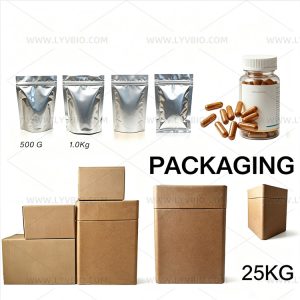
Embalaje1 kg, 5 kg, 10 kg, 25 kg (saco de polietileno de doble capa en el interior, bidón de fibra en el exterior)
Calle Main, 280, Xi'an, Shaanxi, China
LyvBio S.L.
Correo electrónico: info@lyvbio.com
Room,5-0203, Courtyard 205, Lianhu District,Xi'an,Shaanxi,China
 English English
  Russian
 French
 Korean
 German
 Polish
 Japanese
 Spanish
 Italian
 Vietnamese