
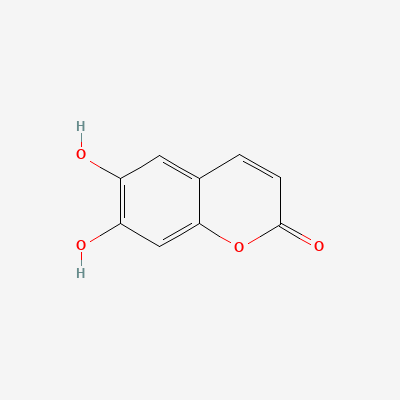
| Tên sản phẩm | Esculetin |
|---|---|
| Số CAS | 305-01-1 |
| Công thức phân tử | C9H6O4 |
| Trọng lượng phân tử | 178.14 |
| Hình thức | White to pale yellow crystalline powder |
| Phương pháp định lượng | ≥98,01% TP3T (HPLC) |
| Mất mát khi sấy khô | ≤0,51 TP3T |
| Hàm lượng tro sau khi đốt | ≤0,11 TP3T |
| Kim loại nặng | ≤10 ppm |
| Độ hòa tan | Soluble in ethanol, DMSO, and hot water; sparingly soluble in cold water |
| Gói | 1kg, 5kg, 25kg (customized on request) |
| Thông số kỹ thuật | 98% |
Cần trợ giúp? Liên hệ với đội ngũ của chúng tôi
Synonyms: Esculetin, 6,7-Dihydroxycoumarin, Cichorigenin, Aesculetin, Esculetol
Esculetin is a naturally occurring coumarin derivative characterized by a benzopyrone core with hydroxyl groups at the 6 and 7 positions. This dihydroxy substitution pattern imparts significant antioxidant and metal-chelating properties, distinguishing it from simple coumarins. The compound is found in various medicinal plants, including Fraxinus species (ash bark), Artemisia species, and Citrus fruits, and has been a subject of interest for its diverse pharmacological activities.
As a high-purity chemical reference, Esculetin (CAS 305-01-1) is supplied as a crystalline powder, typically with a purity of ≥98% (HPLC). It is widely employed in research settings to investigate its anti-inflammatory, antioxidant, and anti-proliferative effects, as well as in the development of nutraceutical and pharmaceutical formulations. Its role as a biochemical tool in studying enzyme inhibition and signal transduction pathways further underscores its value in life sciences.
For B2B buyers, consistent quality and reliable supply are paramount. Our Esculetin is produced under controlled conditions, with each batch rigorously tested to ensure compliance with the specified purity and physicochemical parameters. We provide comprehensive documentation, including COA, MSDS, and TDS, to support your quality assurance and regulatory needs.
Esculetin (6,7-dihydroxycoumarin) belongs to the coumarin family, which shares a common 1-benzopyran-2-one skeleton. The presence of two adjacent hydroxyl groups on the aromatic ring allows for efficient free radical scavenging and chelation of transition metal ions, contributing to its antioxidant capacity. The compound exhibits strong UV absorption with maxima around 340 nm, making it detectable by HPLC for precise quantification. Its moderate lipophilicity (log P ~1.3) facilitates cell membrane permeability, which is relevant for its bioactivity in cellular models.
| Tham số | Thông số kỹ thuật |
|---|---|
| Hình thức | White to pale yellow crystalline powder |
| Phương pháp phân tích (HPLC) | ≥98,01 TP3T |
| Điểm nóng chảy | 268–272°C (decomposes) |
| Mất mát khi sấy khô | ≤0,51 TP3T |
| Hàm lượng tro sau khi đốt | ≤0,11 TP3T |
| Kim loại nặng | ≤10 ppm |
| Độ hòa tan | Soluble in ethanol, DMSO, hot water; sparingly in cold water |
Room,5-0203, Courtyard 205, Lianhu District,Xi'an,Shaanxi,China
 English English
  Russian
 French
 Korean
 German
 Polish
 Japanese
 Spanish
 Italian
 Vietnamese