
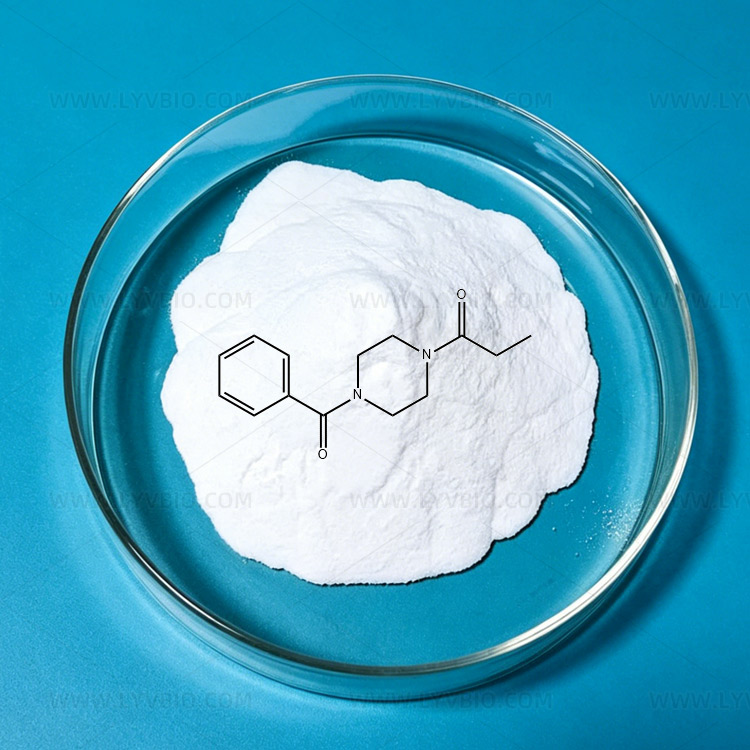
| Nazwa produktu | Sunifiram |
| Synonimy | DM-235; DM235; 1-Benzoyl-4-propanoylpiperazine; 1-(4-Benzoylpiperazin-1-yl)propan-1-one; 1-Benzoyl-4-(1-oxopropyl)piperazine |
| Numer CAS | 314728-85-3 |
| Wzór cząsteczkowy | C₁₄H₁₈N₂O₂ |
| Masa cząsteczkowa | 246.30 g/mol |
| Wygląd | Biały lub prawie biały krystaliczny proszek |
| Oznaczenie (HPLC) | ≥ 99,01 TP3T |
| Temperatura topnienia | 86–89°C |
| Strata przy suszeniu | ≤ 0,5% |
| Popiół po spaleniu | ≤ 0,11 TP3T |
| Metale ciężkie | ≤ 10 ppm |
| Przechowywanie | W chłodnym, suchym miejscu, w zamkniętym opakowaniu, chronione przed światłem |
| Okres przydatności do spożycia | 36 miesięcy |
Potrzebujesz pomocy? Skontaktuj się z naszym zespołem
Sunifiram (developmental code DM-235) is a silnie działający związek nootropowy belonging to the piperazine class.
It was developed as a next-generation cognitive enhancer with significantly higher potency than the classic racetam family (piracetam, aniracetam).
Sunifiram is structurally distinct from racetams but shares similar glutamatergic mechanisms.
Sunifiram is estimated to be około 1000 razy silniejszy niż piracetam w modelach zwierzęcych.
It acts as a positive allosteric modulator of AMPA receptors and may also influence nicotinic acetylcholine receptors (nAChRs).
Unlike many racetams, sunifiram does not require metabolic activation.

Sunifiram Nootropic Supplement
Sunifiram was developed by researchers at the University of Florence, Italy, as part of a series of potent ampakine-like compounds. Along with Unifiram (DM-232), it was designed to overcome the low potency limitations of traditional racetams. Preclinical studies demonstrated cognitive-enhancing effects at microgram-per-kilogram doses—orders of magnitude lower than piracetam (which requires milligram-per-kilogram doses).
Sunifiram exerts its effects primarily through glutamatergic modulation:
| Ścieżka | Proposed Mechanism | Cognitive Effect |
|---|---|---|
| AMPA receptor positive allosteric modulation | Enhances glutamate-induced currents; increases synaptic plasticity | Memory consolidation, learning, attention |
| Nicotinic acetylcholine receptor (nAChR) modulation | May influence α7 nAChR subtypes (preliminary) | Focus, working memory |
| Cholinergic enhancement | Indirect (via glutamatergic-cholinergic interaction) | Learning, memory |
| Wniosek | Opis | End Users |
|---|---|---|
| AMPA receptor research | Studying positive allosteric modulation of AMPA receptors | Academic neuroscience, pharmacology labs |
| Cognitive enhancement studies | In vitro and animal models of memory, learning, attention | Behavioral neuroscience research |
| Scopolamine-induced amnesia models | Reversal of cholinergic deficit (Alzheimer’s research models) | Neuropharmacology, drug discovery |
| Comparative nootropic research | Potency comparisons with racetams and other ampakines | Pharmaceutical R&D |
| Research Focus | Wniosek |
|---|---|
| Piperazine vs. pyrrolidone scaffolds | Comparing structural requirements for AMPA modulation |
| Derivative synthesis | Developing novel sunifiram analogs with improved properties |
| Receptor binding studies | Characterizing AMPA receptor subtype selectivity |
| Wniosek | Opis |
|---|---|
| Reference standard | HPLC, LC-MS method development |
| Impurity profiling | For custom synthesis quality control |
| Stability studies | Forced degradation, long-term stability |
LyvBio Sp. z o.o. is a GMP-certified supplier of high-purity Sunifiram for research and development applications.
Możliwości dostawcze:
Oznaczenie (HPLC): ≥99,01 TP3T
Formularz: Proszek krystaliczny
Miesięczna wydajność: 5+ kg
Duże ilości: 1g – 5kg
Czas realizacji: 3–5 dni (próbki), 10–15 dni (towar luzem)
Dokumentacja: COA, MSDS,HNMR, HPLC chromatogram, stability data
Zapewnienie jakości:
Czystość określona metodą HPLC z detekcją UV
Zbadano zawartość pozostałości rozpuszczalników (zgodność z normą USP )
Badane metale ciężkie (ICP-MS)
Potwierdzenie struktury (NMR na życzenie)
📧 Zapytania: info@lyvbio.com
| Parametr | Specyfikacja | Metoda badawcza |
|---|---|---|
| Oznaczenie (HPLC) | ≥ 99,01 TP3T | HPLC-UV (254 nm) |
| Wygląd | Biały lub prawie biały krystaliczny proszek | Wizualne |
| Identyfikacja | Czas retencji w HPLC, NMR (na życzenie) | HPLC / NMR |
| Temperatura topnienia | 86–89°C | USP |
| Strata przy suszeniu | ≤ 0,5% | USP |
| Popiół po spaleniu | ≤ 0,11 TP3T | USP |
| Metale ciężkie | Pb ≤ 10 ppm; As ≤ 2 ppm; Cd ≤ 1 ppm; Hg ≤ 0,1 ppm | ICP-MS |
| Substancje pokrewne | Zanieczyszczenie pojedyncze ≤ 0,51 TP3T; Łącznie ≤ 1,01 TP3T | HPLC-UV |
| Pozostałości rozpuszczalników | Poznaj normę USP | GC |
| Wielkość cząstek | 95% do sita o rozmiarze 80 | Analiza sitowa |
Q: Is Sunifiram the same as Piracetam or Aniracetam?
A: No. Sunifiram is a structurally distinct piperazine derivative, not a racetam. It is estimated to be approximately 1,000 times more potent than piracetam in animal models.
Q: Is Sunifiram FDA-approved for medical use?
O: Nie. Sunifiram has no approved medical use in any major market. It is a research chemical for laboratory use only. No human clinical trials have been published.
Q: What is the difference between Sunifiram and Unifiram (DM-232)?
A: Both are piperazine derivatives developed by the same research group. They have similar potency (~1,000x piracetam) but different chemical structures (different substituents on the piperazine ring). Unifiram is CAS 219694-40-3.
Q: What is the mechanism of action of Sunifiram?
A: Sunifiram is believed to act as a positive allosteric modulator of AMPA receptors (an ampakine). It may also influence nicotinic acetylcholine receptors. Detailed receptor binding studies are limited.
Pytanie: Jaki jest zakres dawek skutecznych w badaniach na zwierzętach?
A: Published studies report cognitive-enhancing effects at 0.01–0.1 mg/kg (oral) in rodents—approximately 1,000 times more potent than piracetam.
Q: Are there human clinical trials for Sunifiram?
O: Nie. No human clinical trials have been published. Sunifiram is a research chemical only.
📧 E-mail: info@lyvbio.com
🌐 Strona internetowa: https://www.lyvbio.com
Room,5-0203, Courtyard 205, Lianhu District,Xi'an,Shaanxi,China
 English English
  Russian
 French
 Korean
 German
 Polish
 Japanese
 Spanish
 Italian
 Vietnamese