
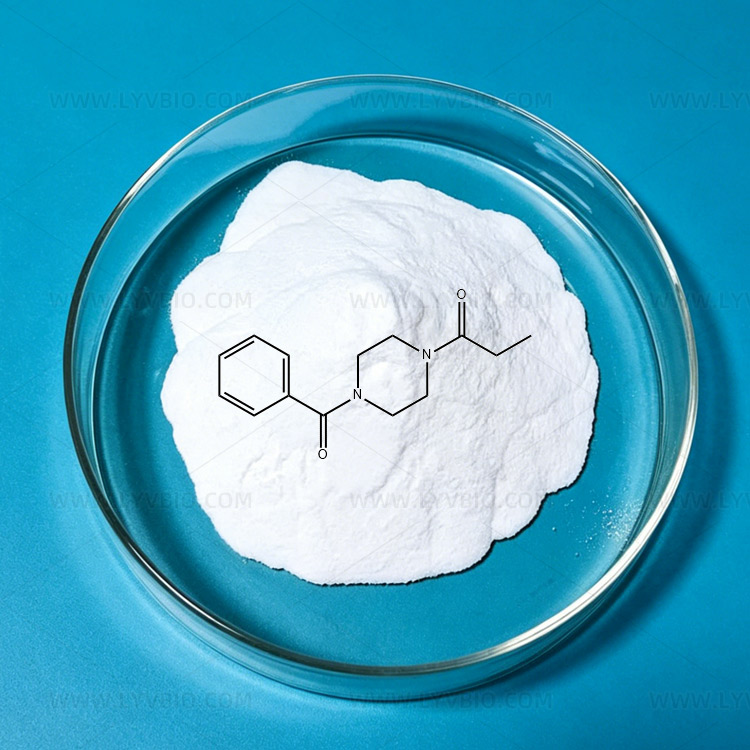
| 제품명 | 수니피람 |
| 동의어 | DM-235; DM235; 1-Benzoyl-4-propanoylpiperazine; 1-(4-Benzoylpiperazin-1-yl)propan-1-one; 1-Benzoyl-4-(1-oxopropyl)piperazine |
| CAS 번호 | 314728-85-3 |
| 분자식 | C₁₄H₁₈N₂O₂ |
| 분자량 | 246.30 g/mol |
| 외관 | 흰색에서 미백색의 결정성 분말 |
| 분석법 (HPLC) | ≥ 99.0% |
| 융점 | 86–89°C |
| 건조 손실 | ≤ 0.5% |
| 소각 잔류물 | ≤ 0.1% |
| 중금속 | 10 ppm 이하 |
| 저장 | 서늘하고 건조하며 밀폐된 곳, 빛을 피한 곳 |
| 유통기한 | 36개월 |
도움이 필요하신가요? 저희 팀에 문의해 주세요
Sunifiram (developmental code DM-235) is a 강력한 노오트로픽 화합물 belonging to the piperazine class.
It was developed as a next-generation cognitive enhancer with significantly higher potency than the classic racetam family (piracetam, aniracetam).
Sunifiram is structurally distinct from racetams but shares similar glutamatergic mechanisms.
Sunifiram is estimated to be 피라세탐보다 약 1,000배 더 강력한 효능을 지님 동물 모델에서.
It acts as a positive allosteric modulator of AMPA receptors and may also influence nicotinic acetylcholine receptors (nAChRs).
Unlike many racetams, sunifiram does not require metabolic activation.

Sunifiram Nootropic Supplement
Sunifiram was developed by researchers at the University of Florence, Italy, as part of a series of potent ampakine-like compounds. Along with Unifiram (DM-232), it was designed to overcome the low potency limitations of traditional racetams. Preclinical studies demonstrated cognitive-enhancing effects at microgram-per-kilogram doses—orders of magnitude lower than piracetam (which requires milligram-per-kilogram doses).
Sunifiram exerts its effects primarily through glutamatergic modulation:
| 진로 | Proposed Mechanism | Cognitive Effect |
|---|---|---|
| AMPA receptor positive allosteric modulation | Enhances glutamate-induced currents; increases synaptic plasticity | Memory consolidation, learning, attention |
| Nicotinic acetylcholine receptor (nAChR) modulation | May influence α7 nAChR subtypes (preliminary) | Focus, working memory |
| Cholinergic enhancement | Indirect (via glutamatergic-cholinergic interaction) | Learning, memory |
| 신청 | 설명 | 최종 사용자 |
|---|---|---|
| AMPA receptor research | Studying positive allosteric modulation of AMPA receptors | Academic neuroscience, pharmacology labs |
| Cognitive enhancement studies | In vitro and animal models of memory, learning, attention | Behavioral neuroscience research |
| Scopolamine-induced amnesia models | Reversal of cholinergic deficit (Alzheimer’s research models) | Neuropharmacology, drug discovery |
| Comparative nootropic research | Potency comparisons with racetams and other ampakines | 제약 연구개발 |
| 연구 중점 분야 | 신청 |
|---|---|
| Piperazine vs. pyrrolidone scaffolds | Comparing structural requirements for AMPA modulation |
| Derivative synthesis | Developing novel sunifiram analogs with improved properties |
| Receptor binding studies | Characterizing AMPA receptor subtype selectivity |
| 신청 | 설명 |
|---|---|
| Reference standard | HPLC, LC-MS method development |
| Impurity profiling | For custom synthesis quality control |
| Stability studies | Forced degradation, long-term stability |
LyvBio 주식회사. is a GMP-certified supplier of high-purity Sunifiram for research and development applications.
공급 역량:
분석법 (HPLC): ≥99.0%
양식: 결정성 분말
월간 처리량: 5kg 이상
대량 주문: 1g – 5kg
소요 기간: 3~5일 (시료), 10~15일 (대량)
문서: COA, MSDS,HNMR, HPLC chromatogram, stability data
품질 보증:
UV 검출을 이용한 HPLC 순도 분석
잔류 용매 검사 결과 (USP 기준 충족)
중금속 분석 (ICP-MS)
구조 확인 (요청 시 NMR 분석)
📧 문의: info@lyvbio.com
| 매개변수 | 사양 | 시험 방법 |
|---|---|---|
| 분석법 (HPLC) | ≥ 99.0% | HPLC-UV (254 nm) |
| 외관 | 흰색에서 미백색의 결정성 분말 | 시각적 |
| 식별 | HPLC 유지 시간, NMR (요청 시) | HPLC / NMR |
| 융점 | 86–89°C | USP |
| 건조 손실 | ≤ 0.5% | USP |
| 소각 잔류물 | ≤ 0.1% | USP |
| 중금속 | Pb ≤ 10 ppm; As ≤ 2 ppm; Cd ≤ 1 ppm; Hg ≤ 0.1 ppm | ICP-MS |
| 관련 물질 | 단일 불순물 ≤ 0.5%; 총 불순물 ≤ 1.0% | HPLC-UV |
| 잔류 용매 | USP 소개 | GC |
| 입자 크기 | 95% ~ 80 메쉬 | 체 분석 |
Q: Is Sunifiram the same as Piracetam or Aniracetam?
A: No. Sunifiram is a structurally distinct piperazine derivative, not a racetam. It is estimated to be approximately 1,000 times more potent than piracetam in animal models.
Q: Is Sunifiram FDA-approved for medical use?
A: 아니요. Sunifiram has no approved medical use in any major market. It is a research chemical for laboratory use only. No human clinical trials have been published.
Q: What is the difference between Sunifiram and Unifiram (DM-232)?
A: Both are piperazine derivatives developed by the same research group. They have similar potency (~1,000x piracetam) but different chemical structures (different substituents on the piperazine ring). Unifiram is CAS 219694-40-3.
Q: What is the mechanism of action of Sunifiram?
A: Sunifiram is believed to act as a positive allosteric modulator of AMPA receptors (an ampakine). It may also influence nicotinic acetylcholine receptors. Detailed receptor binding studies are limited.
Q: 동물 실험에서 유효 용량 범위는 어떻게 됩니까?
A: Published studies report cognitive-enhancing effects at 0.01–0.1 mg/kg (oral) in rodents—approximately 1,000 times more potent than piracetam.
Q: Are there human clinical trials for Sunifiram?
A: 아니요. No human clinical trials have been published. Sunifiram is a research chemical only.
📧 이메일: info@lyvbio.com
🌐 웹사이트: https://www.lyvbio.com
Room,5-0203, Courtyard 205, Lianhu District,Xi'an,Shaanxi,China
 English English
  Russian
 French
 Korean
 German
 Polish
 Japanese
 Spanish
 Italian
 Vietnamese