
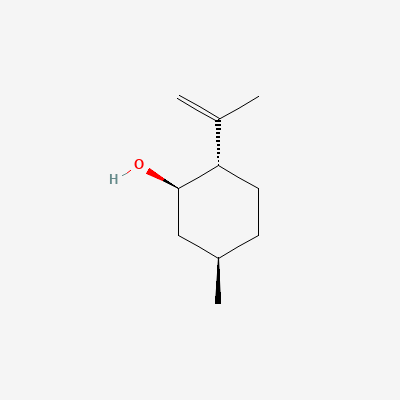
Isopulegol
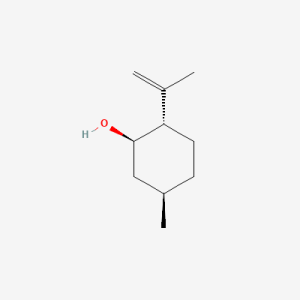
| 제품명 | Isopulegol |
|---|---|
| CAS 번호 | 89-79-2 |
| 분자식 | C10H18O |
| 분자량 | 154.25 g/mol |
| 외관 | Colorless to pale yellow liquid |
| Assay (GC) | ≥98.0% (sum of isomers) |
| Specific Rotation | [α]D20 −8° to −12° (neat) |
| Refractive Index | n20/D 1.470–1.475 |
| 용해도 | Soluble in ethanol, oils; practically insoluble in water |
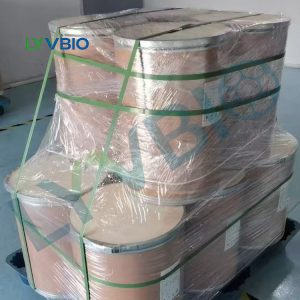
| 패키지 | 25 kg, 180 kg drums |
도움이 필요하신가요? 저희 팀에 문의해 주세요
동의어: 2-Isopropenyl-5-methylcyclohexanol, p-Menth-8-en-3-ol, 5-Methyl-2-(prop-1-en-2-yl)cyclohexanol, Isopulegol, 89-79-2
Isopulegol is a monoterpene alcohol with a cyclohexane backbone bearing a hydroxyl group at C3 and an isopropenyl substituent at C2. This arrangement places it among the p-menthane alcohols, a family that includes menthol and its isomers. The molecule exists as several stereoisomers, with the (−)-isomer being the most common in commercial channels. Its structure combines a rigid ring with a pendant double bond, giving it a distinct reactivity profile and making it a versatile intermediate in synthetic and formulation chemistry.
Naturally occurring in a range of essential oils—most notably citronella, geranium, and certain Mentha species—isopulegol is typically obtained through the cyclization of citronellal. This acid-catalyzed process is a classic example of a carbonyl-ene reaction and is practiced at industrial scale. The resulting product is a mixture of stereoisomers, which can be separated or used as-is depending on the application. Commercial grades are available with purities exceeding 98%, often specified as a sum of isomers, and are supplied as colorless to pale yellow liquids.
As an intermediate, isopulegol serves as a direct precursor to (−)-menthol, one of the most widely used cooling agents in the world. Beyond that, it appears in the synthesis of other fragrance ingredients, such as isopulegyl acetate, and is itself valued for its fresh, minty odor with a slightly woody nuance. Formulators use it in flavor and fragrance compositions, while chemists employ it as a chiral building block for more complex molecules. Its reactivity—particularly the double bond and hydroxyl group—allows for a range of derivatizations, from esterification to epoxidation.
In recent years, isopulegol has drawn interest beyond traditional applications. Its ability to act as a substrate in heterocyclic synthesis, for instance in the formation of oxygen-containing rings, has been explored in academic and industrial research. This has opened up possibilities in medicinal chemistry and materials science, where its rigid scaffold can impart specific properties. For B2B buyers, this dual role—established intermediate and emerging building block—makes isopulegol a compound worth keeping on the radar.
Isopulegol is a monocyclic monoterpenoid alcohol. Its molecular framework consists of a cyclohexane ring with a hydroxyl group at position 3 and an isopropenyl group at position 2, giving it the systematic name 2-isopropenyl-5-methylcyclohexanol. The presence of both a hydroxyl and a double bond allows for diverse chemical transformations. The compound is a clear, colorless to pale yellow liquid at room temperature, with a characteristic minty, slightly woody odor. It is miscible with most organic solvents such as ethanol, ether, and chloroform, but has limited solubility in water. Its specific rotation varies depending on the isomer; the (−)-isopulegol typically exhibits [α]D20 around −10° (neat). The refractive index is generally in the range of 1.470–1.475. These properties make it suitable for use in fragrance and flavor formulations, as well as a chemical intermediate.
| 매개변수 | 사양 |
|---|---|
| 외관 | Colorless to pale yellow liquid |
| Assay (GC, sum of isomers) | ≥98.0% |
| Specific Rotation | [α]D20 −8° to −12° (neat) |
| Refractive Index | 1.470–1.475 (20°C) |
| 용해도 | Soluble in ethanol, oils; insoluble in water |
| Moisture | ≤0.5% |
| 중금속 | ≤10 ppm |
 English English
 Russian
 French
 Korean
 German
 Polish
 Japanese
 Spanish
 Italian
 Vietnamese