
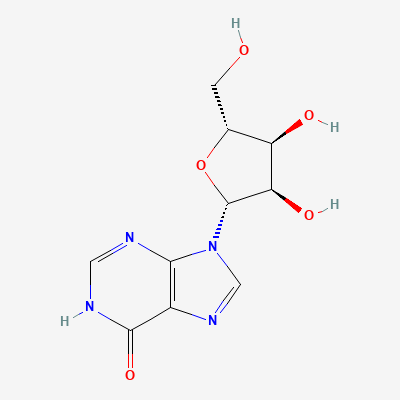
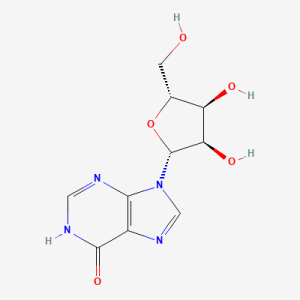
이노신
| 제품명 | 이노신 |
|---|---|
| CAS 번호 | 58-63-9 |
| 다른 이름 | Hypoxanthine riboside; 9-β-D-Ribofuranosylhypoxanthine; Inosine-9-β-D-ribofuranoside |
| 분자식 | C10H12N4O5 |
| 분자량 | 268.23 g/mol |
| 외관 | 흰색에서 미백색의 결정성 분말 |
| 분석법 (HPLC) | ≥99.0% |
| 건조 손실 | ≤0.5% |
| 소각 잔류물 | ≤0.1% |
| 중금속 | ≤10 ppm |
| 용해도 | Slightly soluble in water, practically insoluble in ethanol |
| 입자 크기 | 98% pass 80 mesh |
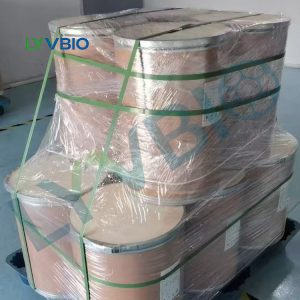
| 패키지 | 25 kg fiber drum with double polyethylene liner |
도움이 필요하신가요? 저희 팀에 문의해 주세요
동의어: Hypoxanthine riboside, 9-β-D-Ribofuranosylhypoxanthine, Inosine-9-β-D-ribofuranoside, Inosine
Inosine is a naturally occurring purine nucleoside formed by the deamination of adenosine, consisting of a hypoxanthine base attached to a ribose sugar via a β-N9-glycosidic bond. While it appears in small quantities in animal tissues and certain plant sources, commercial material is produced through fermentation or chemical synthesis, yielding a high-purity white crystalline powder that meets stringent pharmaceutical standards.
As an intermediate in purine metabolism, inosine serves as a precursor to adenosine and guanosine nucleotides, influencing cellular energy balance and signaling pathways. This central role has made it a valuable molecule for pharmaceutical research, nutraceutical formulations, and biochemical assays. Its ability to modulate adenosine receptors and support ATP regeneration has attracted interest in areas ranging from cardiovascular health to neuroprotection.
| 매개변수 | 사양 |
|---|---|
| 분석법 (HPLC) | ≥99.0% |
| 외관 | 흰색에서 미백색의 결정성 분말 |
| 식별 | IR and HPLC conform to reference standard |
| 건조 손실 | ≤0.5% |
| 소각 잔류물 | ≤0.1% |
| 중금속 | ≤10 ppm |
| 용해도 | Slightly soluble in water, practically insoluble in ethanol |
 English English
 Russian
 French
 Korean
 German
 Polish
 Japanese
 Spanish
 Italian
 Vietnamese