

Sodium Taurodeoxycholate
| Nom du produit | Sodium Taurodeoxycholate |
|---|---|
| Numéro CAS | 1180-95-6 |
| Formule moléculaire | C26H44NNaO6S |
| Poids moléculaire | 521.69 g/mol |
| Apparence | Poudre cristalline blanche à blanc cassé |
| Essai (HPLC) | ≥97.0% |
| Perte au séchage | ≤5,01 TP3T |
| Métaux lourds | ≤ 10 ppm |
| Solubilité | Soluble in water and ethanol |
| Colis | 25 kg fiber drum with inner polyethylene bag |
Besoin d'aide ? Contacter notre équipe
Synonymes : Taurodeoxycholic acid sodium salt, Sodium deoxycholyltaurine, TDCA sodium, 2-[(3α,5β,12α)-3,12-Dihydroxy-24-oxocholan-24-yl]aminoethanesulfonic acid sodium salt, Sodium taurodeoxycholate
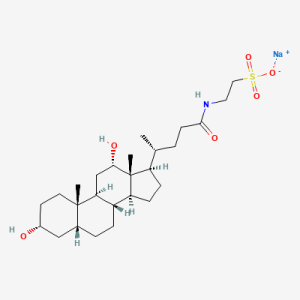
Sodium taurodeoxycholate is the sodium salt of taurodeoxycholic acid, a secondary bile acid conjugated with taurine. Its structure features a steroid nucleus with hydroxyl groups at the 3α and 12α positions, and a taurine moiety linked via an amide bond at the C-24 side chain. This amphipathic nature—a hydrophobic steroid core paired with a hydrophilic sulfonate head—underpins its role as a powerful biological detergent, capable of solubilizing lipids and membrane proteins while maintaining native conformations in aqueous environments.
In living systems, TDCA is produced in the liver from deoxycholic acid and taurine, then secreted into bile. It is a major constituent of bile salts in many mammals, where it facilitates the digestion and absorption of dietary fats and fat-soluble vitamins. For research and industrial applications, sodium taurodeoxycholate is typically manufactured through chemical synthesis or semi-synthesis starting from deoxycholic acid, followed by conjugation with taurine and conversion to the sodium salt. The product is available in high-purity grades suitable for cell culture, protein biochemistry, and pharmaceutical formulation.
Beyond its physiological role, sodium taurodeoxycholate has become a staple in laboratories for membrane protein extraction, liposome preparation, and as a reference standard in bile acid analysis. Its ability to disrupt lipid bilayers without denaturing proteins makes it invaluable in studies of membrane transport, receptor binding, and signal transduction. In the pharmaceutical industry, it serves as a permeation enhancer in intranasal and ocular formulations, and as a solubilizing agent for poorly soluble drugs. Its compatibility with mass spectrometry and chromatography also positions it as a critical tool in metabolomics and clinical diagnostics.
Sodium taurodeoxycholate belongs to the family of taurine-conjugated bile salts. The molecule consists of a 5β-cholanic acid skeleton with α-oriented hydroxyl groups at C-3 and C-12. The side chain terminates in a taurine group (2-aminoethanesulfonic acid) linked through an amide bond, and the sulfonic acid is neutralized as the sodium salt. This configuration confers exceptional water solubility (up to 50 mg/mL) and a low critical micelle concentration (CMC) of approximately 2–6 mM in water at 25°C. The compound is stable under neutral and mildly alkaline conditions, but hydrolyzes under strong acidic conditions, releasing deoxycholic acid and taurine. Its amphipathic character allows it to form mixed micelles with phospholipids and cholesterol, a property that is exploited in both biological and industrial contexts.
| Paramètre | Spécifications |
|---|---|
| Apparence | Poudre cristalline blanche à blanc cassé |
| Essai (HPLC) | ≥97.0% |
| Perte au séchage | ≤5,01 TP3T |
| Résidu au feu | ≤ 0,51 TP3T |
| Métaux lourds | ≤ 10 ppm |
| Solubilité | Soluble in water and ethanol |
| pH (solution 1%) | 6,0–8,0 |
Room,5-0203, Unit 5, Beiyuanmen Street,Xi'an,Shaanxi,China
 English English
 Russian
 French
 Korean
 German
 Polish
 Japanese
 Spanish
 Italian
 Vietnamese