
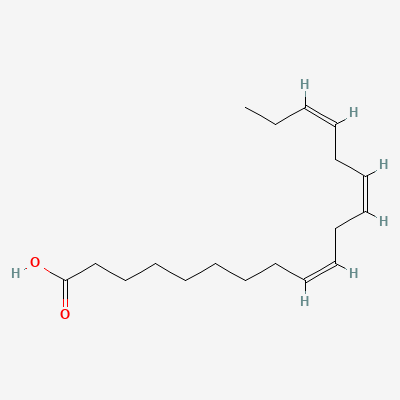
Linolenic acid
| Nom du produit | Linolenic Acid |
|---|---|
| Autres noms | α-Linolenic acid (ALA), (9Z,12Z,15Z)-octadeca-9,12,15-trienoic acid, cis,cis,cis-9,12,15-octadecatrienoic acid |
| Numéro CAS | 463-40-1 |
| Formule moléculaire | C18H30O2 |
| Poids moléculaire | 278.43 g/mol |
| Apparence | Colorless to pale yellow liquid |
| Assay (GC) | ≥99% |
| Iodine Value | 270–280 g I₂/100 g |
| Density | 0.914–0.917 g/cm³ at 20 °C |
| Refractive Index | n20/D 1.480–1.482 |
| Solubilité | Soluble in ethanol, ether, chloroform; practically insoluble in water |
| Stockage | Store under inert gas, protected from light, at –20 °C for long-term storage |
| Colis | 1 kg, 5 kg, 25 kg HDPE drums; custom packaging available |
Besoin d'aide ? Contacter notre équipe
Synonyms: α-Linolenic acid, ALA, (9Z,12Z,15Z)-octadeca-9,12,15-trienoic acid, cis,cis,cis-9,12,15-octadecatrienoic acid, linolenic acid (alpha)
Linolenic acid, specifically α-linolenic acid (ALA), is an 18-carbon polyunsaturated fatty acid (PUFA) characterized by three cis double bonds at positions 9, 12, and 15 along the hydrocarbon chain. This ω-3 fatty acid is a fundamental building block in human nutrition and a precursor to longer-chain ω-3 fatty acids such as eicosapentaenoic acid (EPA) and docosahexaenoic acid (DHA). Its unique structure, with a methylene-interrupted triene system, underpins its distinct chemical reactivity and biological roles.
α-Linolenic acid is widely distributed in plant oils, with flaxseed (linseed), chia, perilla, and walnut oils being particularly rich sources. It is obtained through fractional distillation or low-temperature crystallization of these oils, yielding high-purity fractions suitable for research, pharmaceutical, and nutraceutical applications. LyvBio supplies linolenic acid in various purities, from technical grade to ≥99% GC, to meet the rigorous demands of our global clientele.
In the pharmaceutical and nutraceutical industries, linolenic acid serves as an active ingredient in cardiovascular health supplements, anti-inflammatory formulations, and parenteral nutrition. Its role extends to cosmetic formulations for its emollient and barrier-repair properties, and to biochemical research as a reference standard and substrate in enzymatic studies. The growing body of evidence linking ω-3 fatty acids to metabolic and cognitive health continues to drive demand for high-purity ALA.
Linolenic acid consists of a straight 18-carbon chain terminating in a carboxylic acid group, with three cis double bonds at carbons 9, 12, and 15 (counting from the carboxyl carbon). This configuration imparts a pronounced kink in the molecule, preventing tight packing and resulting in a low melting point (approximately –11 °C) and high fluidity. The conjugated double bonds are prone to oxidation, making the compound sensitive to light, heat, and oxygen; thus, it is typically stabilized with antioxidants such as tocopherols and stored under inert gas. Its iodine value (270–280) reflects the high degree of unsaturation, while its refractive index and density are characteristic of long-chain PUFAs.
| Paramètre | Spécifications |
|---|---|
| Assay (GC) | ≥99,01 TP3T |
| Apparence | Colorless to pale yellow liquid |
| Iodine Value | 270–280 g I₂/100 g |
| Peroxide Value | ≤5.0 meq O₂/kg |
| Métaux lourds | ≤ 10 ppm |
| Water Content | ≤ 0,11 TP3T |
Room,5-0203, Unit 5, Beiyuanmen Street,Xi'an,Shaanxi,China
 English English
 Russian
 French
 Korean
 German
 Polish
 Japanese
 Spanish
 Italian
 Vietnamese