
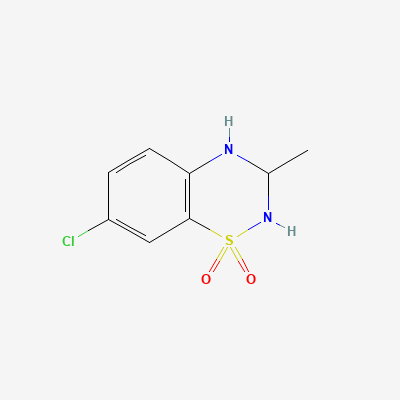
IDRA 21
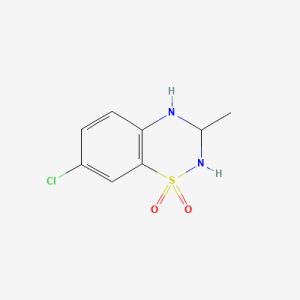
| Nom du produit | IDRA 21 |
|---|---|
| Numéro CAS | 22503-72-6 |
| Formule moléculaire | C8H10N2O2S |
| Poids moléculaire | 198.24 g/mol |
| Apparence | Poudre cristalline blanche à blanc cassé |
| Pureté | ≥98% (HPLC) |
| Solubilité | Soluble in DMSO, methanol; slightly soluble in water |
| Stockage | Store at -20°C, protected from light |
| Colis | 10 mg, 50 mg, 100 mg, 500 mg, 1 g |
Besoin d'aide ? Contacter notre équipe
Synonymes : IDRA 21, 7,8-dihydro-8-oxo-7-(2-hydroxyethyl)-9H-purine-6-carboxaldehyde, 7,8-dihydro-8-oxo-7-(2-hydroxyethyl)guanine, 8-oxo-7-(2-hydroxyethyl)guanine, 22503-72-6
IDRA 21 is a synthetic purine derivative that has garnered attention in neuropharmacology as a positive allosteric modulator of the AMPA receptor. Its chemical structure, featuring a 7,8-dihydro-8-oxo-purine core with a 2-hydroxyethyl side chain, distinguishes it from other AMPA receptor modulators and contributes to its unique pharmacological profile. While not a natural product, IDRA 21 is often studied alongside endogenous purines due to its structural similarity to guanine derivatives.
Initially identified through screening efforts aimed at finding cognitive enhancers, IDRA 21 has become a valuable tool compound for investigating glutamatergic signaling. Unlike direct AMPA receptor agonists, it modulates receptor activity by slowing desensitization, thereby enhancing synaptic responses without inducing excitotoxicity. This mechanism has positioned it as a candidate for addressing cognitive deficits in neurological disorders.
In research settings, IDRA 21 is primarily used to probe the role of AMPA receptors in learning and memory processes. Its ability to cross the blood-brain barrier and its favorable pharmacokinetic profile in animal models make it a subject of interest for preclinical studies. While not yet approved for clinical use, IDRA 21 continues to be a reference compound in the development of next-generation cognitive enhancers.
| Paramètre | Spécifications |
|---|---|
| Essai (HPLC) | ≥98,01 TP3T |
| Identification | NMR, MS conform to structure |
| Perte au séchage | ≤ 0,51 TP3T |
| Résidu au feu | ≤ 0,11 TP3T |
| Métaux lourds | ≤ 10 ppm |
| Limites microbiologiques | Total aerobic count ≤1000 CFU/g |
Room,5-0203, Unit 5, Beiyuanmen Street,Xi'an,Shaanxi,China
 English English
 Russian
 French
 Korean
 German
 Polish
 Japanese
 Spanish
 Italian
 Vietnamese