
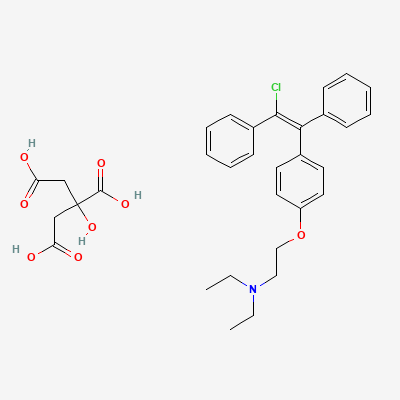
Citrate d'enclomiphène
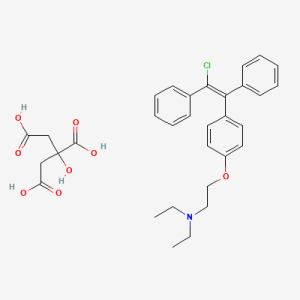
| Nom du produit | Citrate d'enclomiphène |
|---|---|
| Numéro CAS | 7599-79-3 |
| Autres noms | trans-Clomiphene citrate; (E)-Clomiphene citrate; 2-[4-[(E)-2-chloro-1,2-diphenylethenyl]phenoxy]-N,N-diethylethanamine citrate |
| Formule moléculaire | C26H28ClNO·C6H8O7 |
| Poids moléculaire | 598.1 g/mol (citrate salt) |
| Apparence | Poudre cristalline blanche à blanc cassé |
| Essai (HPLC) | ≥98.0% (anhydrous basis) |
| Perte au séchage | ≤ 0,51 TP3T |
| Résidu au feu | ≤ 0,11 TP3T |
| Métaux lourds | ≤ 10 ppm |
| Solubilité | Sparingly soluble in water, freely soluble in ethanol, methanol |
| Colis | Fût en fibre de 25 kg avec double revêtement en polyéthylène |
Besoin d'aide ? Contacter notre équipe
Synonymes : trans-Clomiphene citrate, (E)-Clomiphene citrate, Enclomiphene dihydrogen citrate, 2-[4-[(E)-2-chloro-1,2-diphenylethenyl]phenoxy]-N,N-diethylethanamine citrate
Enclomiphene citrate is the trans-isomer of clomiphene citrate, a selective estrogen receptor modulator (SERM) that has drawn considerable attention in both clinical research and pharmaceutical manufacturing. Unlike its cis counterpart zuclomiphene, which exhibits estrogenic activity, enclomiphene acts as a pure estrogen antagonist in the hypothalamus and pituitary. This distinct pharmacological profile has positioned it as a compound of interest for developing therapies targeting testosterone deficiency and related endocrine disorders.
Chemically, enclomiphene citrate belongs to the triphenylethylene class, sharing structural similarities with tamoxifen and other well-known SERMs. The molecule features a chloro-substituted stilbene core with a diethylaminoethoxy side chain, and its citrate salt form enhances aqueous solubility and stability. The trans configuration is critical for its antagonistic properties; even minor contamination with the cis isomer can significantly alter the pharmacological response, making stereochemical purity a key quality parameter.
In the pharmaceutical supply chain, enclomiphene citrate is typically produced under cGMP conditions and is available in high-purity grades suitable for formulation development and clinical trial materials. It is most commonly used in the development of oral capsules or tablets for hormone modulation, and as a reference standard in analytical laboratories. Its rising profile in men’s health research has led to increased demand for reliable, well-documented sources of this active pharmaceutical ingredient.
| Paramètre | Spécifications |
|---|---|
| Essai (HPLC) | ≥98,01 TP3T |
| Identification | IR, HPLC retention time conforms to standard |
| Cis-isomer | ≤ 0,51 TP3T |
| Perte au séchage | ≤ 0,51 TP3T |
| Résidu au feu | ≤ 0,11 TP3T |
| Métaux lourds | ≤ 10 ppm |
| Limites microbiologiques | Nombre total de bactéries aérobies ≤ 1 000 UFC/g ; levures et moisissures ≤ 100 UFC/g ; absence d'E. coli |
Room,5-0203, Unit 5, Beiyuanmen Street,Xi'an,Shaanxi,China
 English English
 Russian
 French
 Korean
 German
 Polish
 Japanese
 Spanish
 Italian
 Vietnamese