
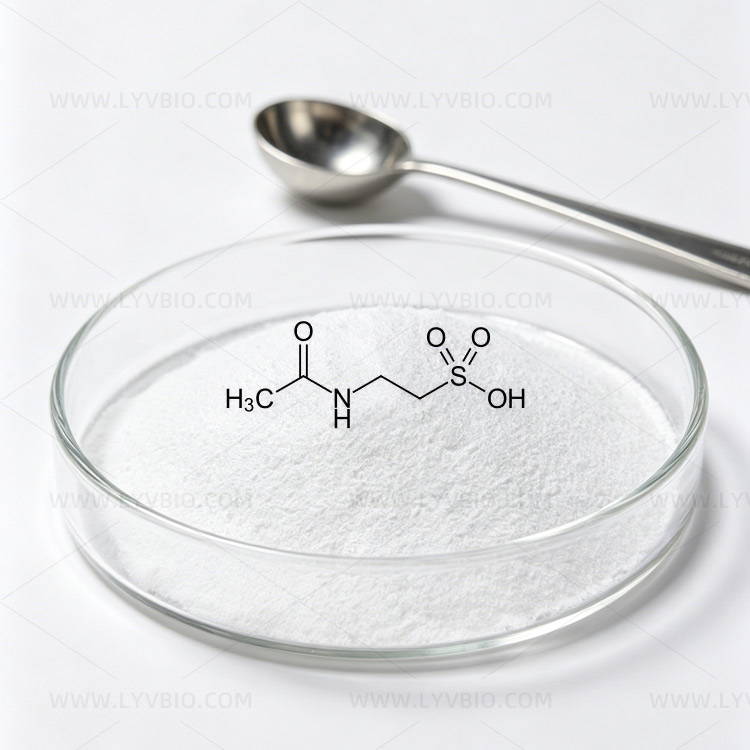
| Nom du produit | Acétyltaurine |
| Numéro CAS | 19213-70-8 |
| Formule moléculaire | C₄H₉NO₄S |
| Poids moléculaire | 167,18 g/mol |
| Apparence | Poudre cristalline blanche à blanc cassé |
| Essai (HPLC) | ≥ 98.0% |
| Perte au séchage | ≤ 0,5% |
| Résidu au feu | ≤ 0,11 TP3T |
| Métaux lourds | ≤ 10 ppm |
Besoin d'aide ? Contacter notre équipe
L'acétyltaurine (N-acétyltaurine) est un métabolite acétylé de la taurine. Il est synthétisé de manière endogène par acétylation de la taurine et joue le rôle de biomarqueur pour le métabolisme de la taurine et certaines affections métaboliques. Il est principalement utilisé comme étalon de référence analytique et recherche intermédiaire.
Synonymes :
N-acétyl-taurine
Acide 2-acétamidoéthanesulfonique
Acide 2-acétamidoéthane-1-sulfonique
Impureté de la taurine n° 3
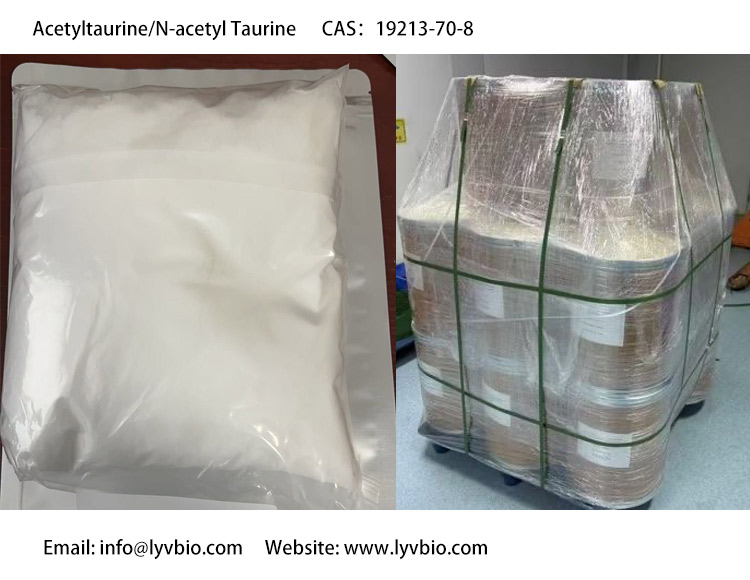
N-acétyl-taurine
| Paramètre | Spécifications | Méthode d'essai |
|---|---|---|
| Essai (HPLC) | ≥ 98.0% | HPLC-UV |
| Apparence | Poudre cristalline blanche à blanc cassé | Visuel |
| Identification | Temps de rétention par HPLC, RMN | HPLC/RMN |
| Perte au séchage | ≤ 0,5% | USP |
| Résidu au feu | ≤ 0,11 TP3T | USP |
| Métaux lourds | ≤ 10 ppm | ICP-MS |
| Substances apparentées | Impureté unique ≤ 0,51 TP3T ; Total ≤ 2,01 TP3T | HPLC-UV |
| Application | Description | Utilisateurs finaux |
|---|---|---|
| Étalon de référence analytique | Profil des impuretés de la taurine (principe actif) | Contrôle qualité pharmaceutique |
| Recherche sur les métabolites | Étude des voies d'acétylation de la taurine | Recherche sur le métabolisme |
| Études sur les biomarqueurs | Biomarqueur du métabolisme de la taurine | Recherche clinique |
| Étalon d'impureté de la taurine | Identification des impuretés de la taurine conforme aux normes EP / USP | Laboratoires de contrôle qualité pharmaceutique |
La pureté : ≥98.0% (HPLC)
Capacité mensuelle : 5 kg et plus
Délai d'exécution : 3-5 jours (échantillons), 10-15 jours (vrac)
Documentation : Certificat d'analyse, fiche de données de sécurité, chromatogramme HPLC
Conditionnement : 500 g – 1 kg
📧 Courriel : info@lyvbio.com
Q : L'acétyltaurine est-elle la même chose que la taurine ?
R : Non. L'acétyltaurine est le métabolite acétylé de la taurine. La taurine est le composé d'origine.
Q : À quoi sert l'acétyltaurine ?
R : Principalement comme étalon de référence analytique pour l'analyse des impuretés de la taurine et la recherche sur son métabolisme.
Q : Quelle est votre quantité minimale de commande ?
R : Échantillons de recherche : 10 g à 100 g. Vente en vrac : 500 g à 1 kg.
Room,5-0203, Courtyard 205, Lianhu District,Xi'an,Shaanxi,China
 English English
  Russian
 French
 Korean
 German
 Polish
 Japanese
 Spanish
 Italian
 Vietnamese