
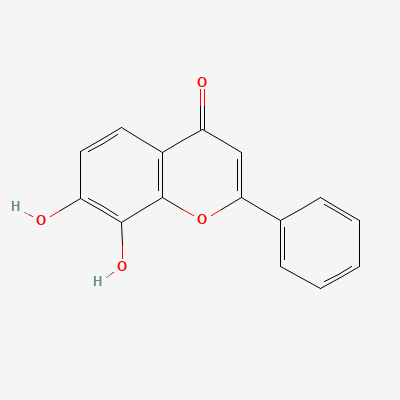
7,8-Dihydroxyflavone (7,8-DHF)
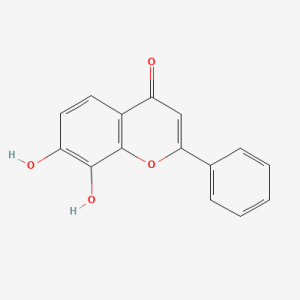
| Nom du produit | 7,8-Dihydroxyflavone |
|---|---|
| Numéro CAS | 38183-03-8 |
| Autres noms | 7,8-DHF; 7,8-Dihydroxy-2-phenyl-4H-chromen-4-one |
| Formule moléculaire | C15H10O4 |
| Poids moléculaire | 254.24 g/mol |
| Apparence | Off-white to pale yellow crystalline powder |
| Essai (HPLC) | ≥98,01 TP3T |
| Point de fusion | 243–246 °C |
| Perte au séchage | ≤ 0,51 TP3T |
| Résidu au feu | ≤ 0,11 TP3T |
| Métaux lourds | ≤ 10 ppm |
| Solubilité | Soluble in DMSO (≥20 mg/mL), ethanol (slightly), practically insoluble in water |
| Granulométrie | 98% through 80 mesh |
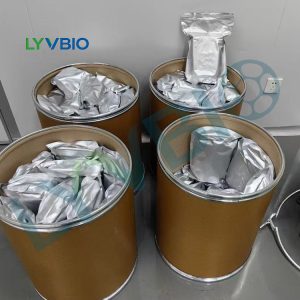
| Colis | 1 kg, 5 kg, 25 kg fiber drums with double LDPE liners |
Besoin d'aide ? Contacter notre équipe
Synonymes : 7,8-DHF, 7,8-Dihydroxy-2-phenyl-4H-chromen-4-one, 7,8-Dihydroxyflavone, 7,8-Dihydroxy-2-phenylchromen-4-one, 4H-1-Benzopyran-4-one, 7,8-dihydroxy-2-phenyl-
7,8-Dihydroxyflavone is a synthetic flavone bearing two adjacent hydroxyl groups at the 7 and 8 positions of the A-ring, a substitution pattern that distinguishes it from the more common 5,7-dihydroxyflavones. This ortho-dihydroxy motif is not merely structural decoration: it underpins the molecule’s redox behavior, metal-chelating tendency, and its unusually high affinity for the tropomyosin-related kinase B (TrkB) receptor. In solution, the compound appears as a pale yellow chromophore with absorption maxima near 340 nm, and its planar aromatic system allows efficient π–π stacking with aromatic residues in the TrkB ligand-binding pocket.
First described in the chemical literature in the 1950s, 7,8-DHF remained a footnote in flavonoid chemistry until 2010, when a high-throughput screen identified it as a small-molecule TrkB agonist capable of mimicking brain-derived neurotrophic factor (BDNF). Since then, it has become a standard research tool in neurobiology and is produced under cGMP-compatible conditions for preclinical and clinical supply. Commercial material is typically offered as off-white to pale yellow crystals with ≥98% purity by HPLC, and it is handled as a light-sensitive solid that should be protected from prolonged exposure to strong light.
Because it is a discrete small molecule rather than a botanical extract, 7,8-DHF offers consistent potency and defined pharmacokinetics—advantages that matter when designing dose-response studies or formulating stable finished products. It is used in research on neurotrophic signaling, synaptic plasticity, and mitochondrial function, and it also serves as a reference standard for analytical method development. The compound is not naturally abundant in common dietary sources, so synthetic routes are the practical route to multi-gram and kilogram quantities.
The flavone core consists of two aromatic rings (A and B) connected through a pyran-4-one ring, with hydroxyl groups at C-7 and C-8. The 7-OH is weakly acidic (pKa ≈ 7.5), while the 8-OH participates in intramolecular hydrogen bonding with the carbonyl oxygen, influencing both the molecule’s UV spectrum and its solubility profile. 7,8-DHF is a neutral, lipophilic solid at room temperature (logP ≈ 2.8) and is practically insoluble in water, a limitation that formulation scientists often address through co-solvents, cyclodextrin complexation, or nano-suspension. It is stable as a solid under cool, dry, dark conditions but can undergo oxidative degradation in alkaline aqueous media, particularly when exposed to air and light.
| Paramètre | Spécifications |
|---|---|
| Essai (HPLC) | ≥98,01 TP3T |
| Apparence | Off-white to pale yellow crystalline powder |
| Identification | IR and UV spectra conform to structure |
| Perte au séchage | ≤ 0,51 TP3T |
| Résidu au feu | ≤ 0,11 TP3T |
| Métaux lourds | ≤ 10 ppm |
| Solvants résiduels | Meets ICH Q3C limits |
Room,5-0203, Unit 5, Beiyuanmen Street,Xi'an,Shaanxi,China
 English English
 Russian
 French
 Korean
 German
 Polish
 Japanese
 Spanish
 Italian
 Vietnamese