
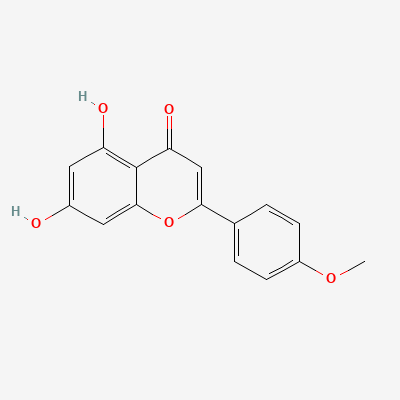
Acacetin
| Produktname | Acacetin |
|---|---|
| CAS-Nummer | 480-44-4 |
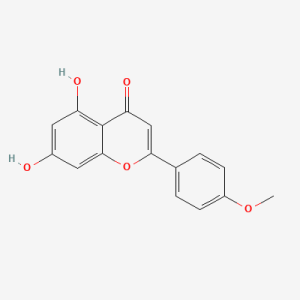
| Andere Bezeichnungen | 5,7-Dihydroxy-4'-methoxyflavone; 4'-Methylapigenin; Apigenin 4'-methyl ether |
| Molekülformel | C16H12O5 |
| Molekulargewicht | 284.26 g/mol |
| Aussehen | Light yellow to yellow crystalline powder |
| Analyse (HPLC) | ≥98,01 TP3T |
| Schmelzpunkt | 260-265°C |
| Löslichkeit | Soluble in DMSO, methanol, ethanol; practically insoluble in water |
| Trocknungsverlust | ≤0,5% |
| Verbrennungsrückstand | ≤0,1% |
| Schwermetalle | ≤ 10 ppm |
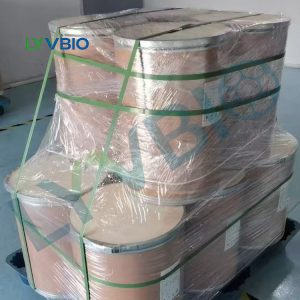
| Verpackung | 25 kg fiber drum with double polyethylene liner |
Brauchst du Hilfe? Kontaktieren Sie unser Team
Synonyme: 5,7-Dihydroxy-4′-methoxyflavone, 4′-Methylapigenin, Apigenin 4′-methyl ether, Acacetin
Acacetin has been drawing steady attention from formulation scientists and procurement teams alike, largely because it sits at the intersection of two strong trends: the push for multi-target flavonoid actives and the demand for well-characterized, scalable botanical compounds. You’ll find it specified in products ranging from sleep and mood support to metabolic and skin-health formulations, where its flavone backbone offers a distinct profile compared to more common flavonols like quercetin or kaempferol.
Chemically, acacetin is the 4′-methyl ether of apigenin, a flavone aglycone widely distributed in the plant kingdom. It was first isolated from Acacia farnesiana and later identified in a range of species including Chrysanthemum morifolium, Robinia pseudoacacia, and various Lamiaceae herbs. Commercial material is typically obtained either through extraction from botanical sources followed by purification, or by semi-synthetic methylation of apigenin—both routes yielding the same crystalline compound.
Our acacetin is supplied as a high-purity crystalline powder, standardized to ≥98.0% by HPLC, with tight control on residual solvents and heavy metals. It is designed for researchers and formulators who need a reliable, reproducible flavone reference standard or a functional active for advanced development work.
Acacetin belongs to the flavone subclass of flavonoids, characterized by a 2-phenylchromen-4-one skeleton. Its substitution pattern—hydroxyl groups at C5 and C7 and a methoxy group at C4’—gives it a more lipophilic character than apigenin, which often translates into different membrane permeability and metabolic stability in vitro. The compound is a single, well-defined entity, not a mixture, and is routinely characterized by HPLC, NMR, and MS for identity confirmation.
Because it is a pure compound rather than an extract, batch-to-batch consistency is high. The material is typically produced under controlled conditions to minimize oxidation and ensure a stable, free-flowing powder. It is compatible with common organic solvents used in formulation and analytical workflows.
| Parameter | Technische Daten |
|---|---|
| Analyse (HPLC) | ≥98,01 TP3T |
| Trocknungsverlust | ≤0,5% |
| Verbrennungsrückstand | ≤0,1% |
| Schwermetalle | ≤ 10 ppm |
| Microbial Limits | Total aerobic count ≤1000 CFU/g; Yeast & Mold ≤100 CFU/g; E. coli absent |
| Residual Solvents | Conforms to ICH Q3C guidelines |
Room,5-0203, Unit 5, Beiyuanmen Street,Xi'an,Shaanxi,China
 English English
 Russian
 French
 Korean
 German
 Polish
 Japanese
 Spanish
 Italian
 Vietnamese