
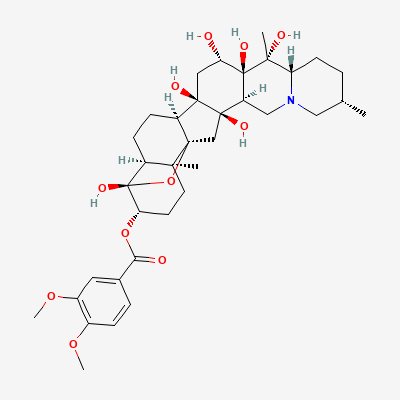
Veratridine
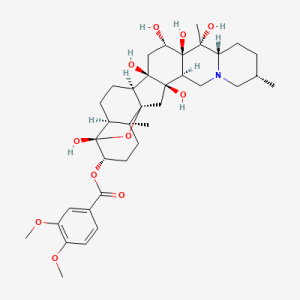
| Parameter | Technische Daten |
|---|---|
| Produktname | Veratridine |
| CAS-Nummer | 71-62-5 |
| Molekülformel | C36H51NO11 |
| Molekulargewicht | 673.79 g/mol |
| Aussehen | Weißes bis cremefarbenes kristallines Pulver |
| Analyse (HPLC) | ≥98,01 TP3T |
| Löslichkeit | Soluble in ethanol, DMSO, methanol; slightly soluble in water |
| Verpackung | 10 mg, 50 mg, 100 mg, 1 g |
Brauchst du Hilfe? Kontaktieren Sie unser Team
Synonyme: 3-Veratroylveracevine, Veratridine, (3β,4α,16β)-4,9-Epoxycevane-3,4,12,14,16,17,20-heptol 3-(3,4-dimethoxybenzoate), Cevane-3,4,12,14,16,17,20-heptol 3-(3,4-dimethoxybenzoate)
Veratridine is a steroidal alkaloid derived from the cevane skeleton, featuring a 3,4-dimethoxybenzoyl ester at the C3 position. This lipophilic moiety enhances its interaction with voltage-gated sodium channels, making it a valuable tool in neuropharmacology. The compound is isolated from plants of the genus Veratrum, such as Veratrum album und Veratrum viride, and is known for its potent effects on ion channel dynamics.
As a research-grade chemical, Veratridine is typically available at ≥98% purity (HPLC). It is widely used in electrophysiology and cell-based assays to study sodium channel function, neurotoxicity, and cardiac arrhythmias. Its ability to lock sodium channels in the open state provides a unique mechanism for investigating excitability and signal transduction.
Beyond basic research, Veratridine serves as a reference standard in analytical method development and as a precursor in the synthesis of derivatives for drug discovery. Its commercial relevance spans pharmaceutical R&D, toxicology, and biochemical reagent supply.
Veratridine belongs to the veratrum alkaloids, characterized by a complex polycyclic cevane framework with multiple hydroxyl groups. The molecule’s amphiphilic nature—combining a polar polyhydroxy core with a nonpolar aromatic ester—facilitates membrane permeability and receptor binding. It is stable under recommended storage conditions but should be protected from light and moisture to prevent hydrolysis of the ester bond.
| Test Item | Technische Daten |
|---|---|
| Identification | NMR, MS conform to structure |
| Trocknungsverlust | ≤2.0% |
| Verbrennungsrückstand | ≤0,5% |
| Schwermetalle | ≤ 10 ppm |
| Microbial Limits | Total aerobic count ≤1000 CFU/g; Yeast & Mold ≤100 CFU/g |
| Related Substances | Total impurities ≤2.0% |
Our standard MOQ is 10 mg. Larger quantities can be accommodated for bulk orders.
For stock items, delivery is typically 3-5 business days from order confirmation.
Yes, a COA is included with every shipment. Samples (typically 10-20 mg) are available for evaluation upon request.
send us your specification for a quotation.
Room,5-0203, Unit 5, Beiyuanmen Street,Xi'an,Shaanxi,China
 English English
 Russian
 French
 Korean
 German
 Polish
 Japanese
 Spanish
 Italian
 Vietnamese