
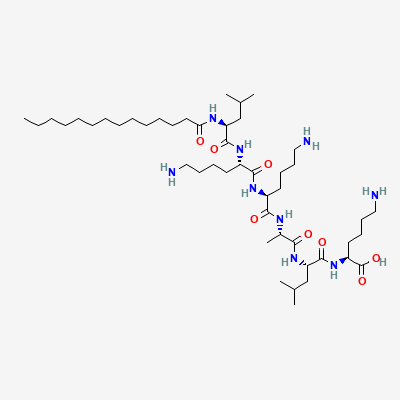
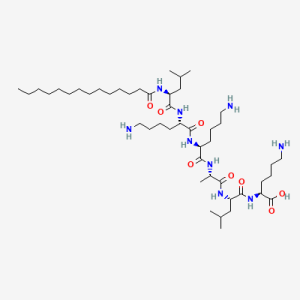

| Product Name | Myristoyl Hexapeptide-16 |
|---|---|
| CAS Number | 959610-54-9 |
| Appearance | White to off-white powder |
| Specifications | Purity ≥98% (HPLC) |
| Molecular Formula | C44H76N6O7 (based on myristoyl hexapeptide) |
| Molecular Weight | ~792.1 g/mol |
| Solubility | Soluble in DMSO, ethanol, and aqueous buffers (with pH adjustment) |
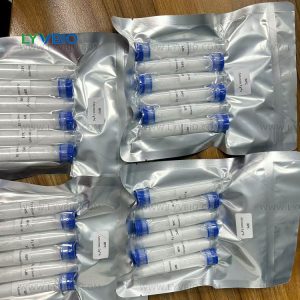
| Package | 5g, 10g, 50g, 100g, or custom |
Need help? Contact our team
Synonyms: Myristoyl Hexapeptide-16, N-Myristoyl-L-prolyl-L-prolyl-L-tyrosyl-L-leucyl-L-prolyl-L-proline, Myristoyl Pro-Pro-Tyr-Leu-Pro-Pro, CAS 959610-54-9
Myristoyl Hexapeptide-16 has been gaining traction in advanced cosmetic and personal care formulations, particularly in the anti-aging segment.
Formulators are increasingly drawn to peptides that offer multi-functional benefits, and this myristoylated hexapeptide stands out for its ability to enhance skin firmness and smoothness while being gentle enough for daily use.
Its lipophilic tail improves penetration and bioavailability, making it a favorite in premium serums, creams, and lotions.
Available at ≥98% purity (HPLC), our Myristoyl Hexapeptide-16 is designed for cosmetic research and formulation.
It is supplied as a fine white powder, soluble in common solvents, and backed by comprehensive documentation.
With flexible packaging options and a low MOQ of 5 grams, it is accessible for both laboratory trials and production scale-ups.
In cosmetic applications, this peptide is typically used at concentrations ranging from 0.5% to 2% in formulations.
It is compatible with a wide range of ingredients, including water, oils, and emulsifiers, and can be incorporated into both aqueous and anhydrous systems.
Its primary function is to support collagen synthesis and reduce the appearance of fine lines, contributing to a more youthful skin appearance.
| Parameter | Specification |
|---|---|
| Appearance | White to off-white powder |
| Assay (HPLC) | ≥98% |
| Loss on Drying | ≤5.0% |
| Heavy Metals | ≤10 ppm |
| Microbial Limits | Total count ≤1000 CFU/g, Yeast & mold ≤100 CFU/g |
| Solubility | Soluble in DMSO, ethanol, and aqueous buffers (with pH adjustment) |
 English English
  Russian
 French
 Korean
 German
 Polish
 Japanese
 Spanish
 Italian
 Vietnamese