
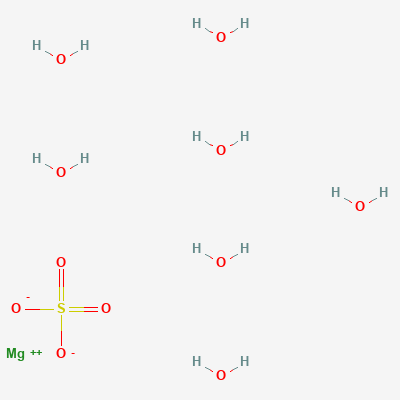
Magnesium sulfate heptahydrate
| Product Name | Magnesium sulfate heptahydrate |
|---|---|
| CAS Number | 10034-99-8 |
| Other Names | Epsom salt, magnesium sulfate heptahydrate, bitter salt, MgSO4·7H2O |
| Molecular Formula | MgSO4·7H2O |
| Molecular Weight | 246.47 g/mol |
| Appearance | Colorless, transparent, or white crystalline solid |
| Assay | ≥99.5% (dried basis) |
| pH (5% solution) | 5.0–8.0 |
| Loss on Drying | 48.0–52.0% (at 150°C) |
| Heavy Metals | ≤10 ppm |
| Solubility | Freely soluble in water, very soluble in boiling water; practically insoluble in ethanol |
| Particle Size | Typically 20–80 mesh (customizable) |
| Package | 25 kg PP woven bags with PE liner, 1000 kg jumbo bags, or as requested |
Need help? Contact our team
Synonyms: Magnesium sulfate heptahydrate, Epsom salt, Bitter salt, MgSO4·7H2O, CAS 10034-99-8
Magnesium sulfate heptahydrate is a white, water-soluble crystalline solid that has been a staple in pharmaceutical, personal care, and industrial formulations for well over a century. Its enduring popularity stems from a rare combination of high magnesium bioavailability, gentle osmotic action, and exceptional safety profile — qualities that keep it in steady demand across laxative, bath soak, and magnesium supplementation categories. In recent years, formulators have also turned to it as a magnesium source in sports recovery and wellness products, where consumer awareness of magnesium’s role in muscle function continues to rise.
Chemically, the compound consists of one magnesium cation, one sulfate anion, and seven molecules of water of crystallization. This heptahydrate form is the most common and stable hydrate under ambient conditions, with a molecular weight of 246.47 g/mol. It occurs naturally as the mineral epsomite and is produced industrially through the reaction of magnesium oxide or magnesium carbonate with sulfuric acid, followed by controlled crystallization. The sulfate component itself contributes to the compound’s osmotic and electrolyte-balancing properties, making it useful beyond magnesium delivery alone.
Commercial grades of magnesium sulfate heptahydrate are typically specified at ≥99.5% purity, with tight control on heavy metals, chloride, and iron content to meet pharmacopeial standards such as USP, BP, and EP. For buyers, the key differentiators are consistent crystal size distribution, low microbial bioburden, and reliable dissolution behavior — factors that directly affect downstream processing and end-product performance.
Magnesium sulfate heptahydrate is an inorganic salt with the formula MgSO4·7H2O, comprising 9.86% magnesium, 39.01% sulfate, and 51.13% water by mass. The heptahydrate lattice is built from [Mg(H2O)6]2+ octahedra linked by sulfate tetrahedra and additional water molecules via hydrogen bonding, which accounts for its well-defined crystal habit and moderate thermal stability. Upon heating, it progressively loses water, transitioning through lower hydrates before becoming anhydrous magnesium sulfate above 250°C.
The compound’s high water solubility — roughly 71 g per 100 mL at 20°C — and clear, colorless solutions make it easy to incorporate into liquid and semi-solid formulations. It is chemically inert toward most excipients, though it can form insoluble precipitates with calcium or phosphate ions under certain conditions, a consideration in multi-mineral formulations. Its neutral to slightly acidic pH in solution supports compatibility with a broad range of topical and oral delivery systems.
| Parameter | Specification |
|---|---|
| Assay (MgSO4·7H2O) | 99.5–100.5% |
| Loss on Drying | 48.0–52.0% |
| Heavy Metals | ≤10 ppm |
| Chloride | ≤0.014% |
| Iron | ≤20 ppm |
| Microbial Limits | Total aerobic count ≤1000 CFU/g; absence of E. coli, Salmonella |
| Mesh Size | 20–80 mesh (customizable) |
Room,5-0203, Unit 5, Beiyuanmen Street,Xi'an,Shaanxi,China
 English English
 Russian
 French
 Korean
 German
 Polish
 Japanese
 Spanish
 Italian
 Vietnamese