
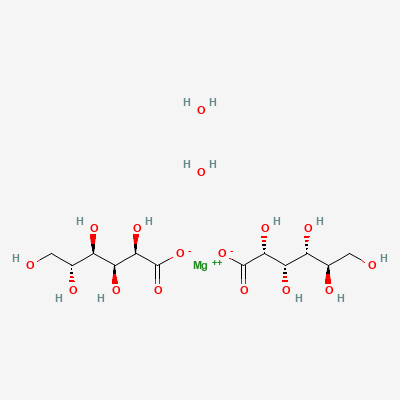
MAGNESIUM GLUCONATE
| Product Name | Magnesium Gluconate |
|---|---|
| CAS Number | 17140-79-3 |
| Molecular Formula | C12H22MgO14 |
| Molecular Weight | 414.6 g/mol |
| Appearance | White to off-white crystalline powder |
| Assay | ≥ 98.0% (dry basis) |
| Solubility | Freely soluble in water; practically insoluble in ethanol |
| Loss on Drying | ≤ 5.0% |
| Heavy Metals | ≤ 10 ppm |
| Package | 25 kg fiber drum with double PE liner |
Need help? Contact our team
Synonyms: Magnesium D-gluconate, Gluconic acid magnesium salt, Magnesium gluconate hydrate, D-Gluconic acid magnesium salt, Magnesium gluconate USP
Magnesium gluconate is the magnesium salt of gluconic acid, a naturally occurring polyhydroxy acid derived from glucose via fermentation. In this chelated form, the magnesium ion is bound to two gluconate moieties, yielding a highly water-soluble and bioavailable mineral source. Since the mid-20th century, magnesium gluconate has been used clinically to correct hypomagnesemia and as a dietary supplement, prized for its gentle gastrointestinal profile compared with inorganic magnesium salts.
Structurally, magnesium gluconate consists of a central magnesium cation coordinated with two gluconate anions. This organic complexation shields the mineral from precipitation in the intestinal tract, enhancing absorption through both passive and active transport pathways. The compound is widely utilized in oral magnesium supplements, effervescent tablets, and parenteral nutrition formulations where a well-tolerated, readily soluble magnesium source is required.
Commercial magnesium gluconate is typically produced by reacting gluconic acid with magnesium oxide or magnesium carbonate, followed by purification and spray-drying. It is standardized to a magnesium content of 5.8–6.0% and is available in USP/EP grades. Its excellent solubility and neutral taste make it a preferred choice for liquid and powdered drink mixes, as well as for clinical nutrition products.
| Parameter | Specification |
|---|---|
| Assay (dry basis) | 98.0% – 102.0% |
| Identification | IR spectrum conforms to reference standard |
| Loss on Drying | ≤ 5.0% |
| Heavy Metals | ≤ 10 ppm |
| Lead | ≤ 2 ppm |
| Microbial Limits | Total aerobic count ≤ 1000 cfu/g; Yeast & Mold ≤ 100 cfu/g; E. coli absent |
Room,5-0203, Unit 5, Beiyuanmen Street,Xi'an,Shaanxi,China
 English English
 Russian
 French
 Korean
 German
 Polish
 Japanese
 Spanish
 Italian
 Vietnamese