
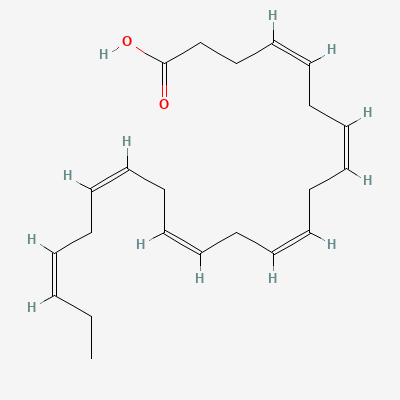
Docosahexaenoic Acid
| Product Name | Docosahexaenoic Acid |
|---|---|
| CAS Number | 6217-54-5 |
| Appearance | Colorless to pale yellow oil |
| Specifications | ≥98% (GC) |
| Molecular Formula | C22H32O2 |
| Molecular Weight | 328.49 g/mol |
| Solubility | Soluble in ethanol, DMSO, and most organic solvents; practically insoluble in water |
| Package | 1 kg, 5 kg, 25 kg in amber glass bottles or aluminum drums |
Need help? Contact our team
Synonyms: DHA, cervonic acid, docosahexaenoic acid, all-cis-4,7,10,13,16,19-docosahexaenoic acid, 22:6n-3, (4Z,7Z,10Z,13Z,16Z,19Z)-docosa-4,7,10,13,16,19-hexaenoic acid
Docosahexaenoic acid (DHA) is a 22-carbon omega-3 fatty acid with six cis double bonds, the first at the fourth carbon from the methyl end. This unique structure—a long, kinked hydrocarbon chain terminating in a carboxylic acid—confers remarkable flexibility and fluidity to cell membranes, particularly in the brain and retina. The six double bonds also make DHA highly susceptible to oxidation, which is why commercial production demands strict control of light, heat, and oxygen.
In nature, DHA originates from marine algae and accumulates in fish oil. For supplement and pharmaceutical use, it is typically derived from microalgae (e.g., Schizochytrium sp.) or purified from fish oil. LyvBio offers algae-sourced DHA as a clear, low-odor oil standardized to ≥98% by GC, suitable for vegan and allergen-free formulations. The high purity makes it ideal for clinical nutrition, infant formula, and research applications where consistent dosing is critical.
Beyond its well-known role in cardiovascular and cognitive health, DHA serves as a precursor to specialized pro-resolving mediators (SPMs) such as resolvins and protectins. These metabolites actively resolve inflammation, a mechanism that has attracted interest in areas ranging from neuroprotection to immune modulation. For formulators, DHA’s challenge lies in stability; our oil is stabilized with natural tocopherols and delivered under nitrogen to preserve potency.
DHA is a polyunsaturated fatty acid (PUFA) with the shorthand notation 22:6 n-3. Its six methylene-interrupted cis double bonds create a curved, helical conformation that occupies a larger cross-sectional area than saturated fatty acids. This property underlies its biological effects on membrane order and lipid raft formation. The carboxylic acid head group allows for esterification into phospholipids and triglycerides. In its free acid form, DHA is a pale yellow oil with a characteristic faint marine odor; it is sensitive to oxidation, light, and heat, and should be stored under inert gas at low temperatures.
| Parameter | Specification |
|---|---|
| Assay (GC) | ≥98% |
| Appearance | Colorless to pale yellow oil |
| Acid Value | ≤1.0 mg KOH/g |
| Peroxide Value | ≤5.0 meq/kg |
| Heavy Metals | ≤10 ppm |
| Residual Solvents | ≤5000 ppm (ethanol) |
Room,5-0203, Unit 5, Beiyuanmen Street,Xi'an,Shaanxi,China
 English English
 Russian
 French
 Korean
 German
 Polish
 Japanese
 Spanish
 Italian
 Vietnamese