

Dehydrocholic Acid
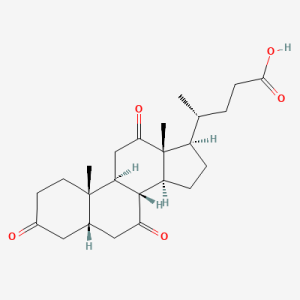
| Product Name | Dehydrocholic Acid |
|---|---|
| CAS Number | 81-23-2 |
| Other Names | 3,7,12-Trioxo-5β-cholan-24-oic acid; Dehydrocholate; DHCA |
| Molecular Formula | C24H34O5 |
| Molecular Weight | 402.52 g/mol |
| Appearance | White to off-white crystalline powder |
| Assay (HPLC) | ≥98.0% |
| Melting Point | 233-237°C (decomposes) |
| Solubility | Soluble in ethanol, acetone; slightly soluble in water |
| Loss on Drying | ≤0.5% |
| Residue on Ignition | ≤0.1% |
| Heavy Metals | ≤10 ppm |
| Package | 25 kg fiber drum with inner polyethylene bag |
Need help? Contact our team
Synonyms: 3,7,12-Trioxo-5β-cholan-24-oic acid; Dehydrocholate; DHCA; 5β-Cholan-24-oic acid, 3,7,12-trioxo-; Triketocholanic acid
Dehydrocholic acid is a synthetic bile acid derivative characterized by three ketone groups at positions 3, 7, and 12 on the steroid nucleus. This oxidation pattern distinguishes it from natural bile acids like cholic acid, which carry hydroxyl groups at these positions. The resulting flat, rigid structure enhances its interaction with hepatic transporters and enzymes, making it a valuable tool in pharmaceutical research and a key intermediate in the synthesis of other bile acid analogs.
Commercially, dehydrocholic acid is produced through the oxidation of cholic acid, typically using chromic acid or other oxidizing agents. It is available in high purity grades, often exceeding 98% as determined by HPLC. The compound is a white to off-white crystalline powder, sparingly soluble in water but freely soluble in organic solvents such as ethanol and acetone. Its stability under normal storage conditions makes it suitable for various applications.
In the pharmaceutical industry, dehydrocholic acid serves as a choleretic agent, stimulating bile production and flow. It is also used as an intermediate in the manufacture of ursodeoxycholic acid and other therapeutic bile acids. Research applications include studies on bile acid metabolism, liver function, and drug delivery systems. Its unique chemical properties continue to drive interest in both medicinal chemistry and process development.
Dehydrocholic acid belongs to the family of C24 bile acids, featuring a steroid nucleus with a carboxyl side chain. The three ketone groups at C3, C7, and C12 create a more planar and hydrophobic molecule compared to its hydroxylated counterparts. This structural feature influences its physicochemical behavior, including its solubility profile and chromatographic retention. The compound exhibits strong UV absorption due to the conjugated ketone system, which facilitates its detection and quantification.
| Parameter | Specification |
|---|---|
| Appearance | White to off-white crystalline powder |
| Assay (HPLC) | ≥98.0% |
| Melting Point | 233-237°C (decomposes) |
| Loss on Drying | ≤0.5% |
| Residue on Ignition | ≤0.1% |
| Heavy Metals | ≤10 ppm |
| Solubility | Soluble in ethanol, acetone; slightly soluble in water |
Room,5-0203, Unit 5, Beiyuanmen Street,Xi'an,Shaanxi,China
 English English
 Russian
 French
 Korean
 German
 Polish
 Japanese
 Spanish
 Italian
 Vietnamese