
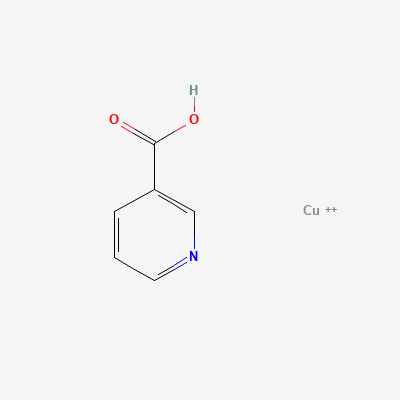
Copper Nicotinate
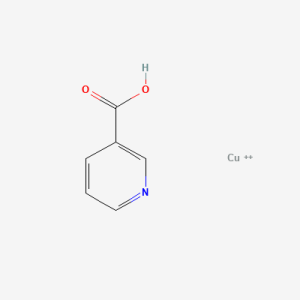
| Product Name | Copper Nicotinate |
|---|---|
| Other Names | Nicotinic acid copper salt; Copper(II) nicotinate; Copper pyridine-3-carboxylate |
| CAS Number | 30827-46-4 |
| Molecular Formula | C12H8CuN2O4 |
| Molecular Weight | 307.75 g/mol |
| Appearance | Blue to blue-green crystalline powder |
| Assay (HPLC) | ≥98.0% (on dried basis) |
| Solubility | Slightly soluble in water; soluble in dimethyl sulfoxide (DMSO), dimethylformamide (DMF); practically insoluble in ethanol, acetone |
| Loss on Drying | ≤1.0% |
| Heavy Metals | ≤10 ppm |
| Particle Size | 98% pass through 80 mesh |
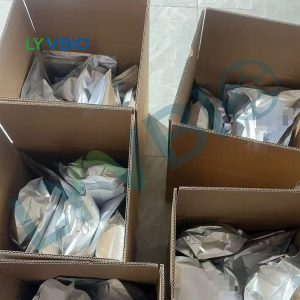
| Package | 25 kg net weight in fiber drums with double polyethylene liners |
Need help? Contact our team
Synonyms: Copper Nicotinate, Nicotinic acid copper salt, Copper(II) nicotinate, Copper pyridine-3-carboxylate, Bis(nicotinato)copper(II), Copper nicotinate complex
Copper Nicotinate is a coordination compound formed between copper(II) ions and nicotinic acid (vitamin B3) ligands, typically in a 1:2 metal-to-ligand ratio. This complex combines the essential trace element copper with the vitamin B3 derivative, offering a dual-action ingredient that has garnered interest in pharmaceutical, nutraceutical, and cosmetic applications. Unlike simple copper salts, the chelated structure of Copper Nicotinate enhances its stability and may improve bioavailability, making it a preferred choice for formulators seeking efficient delivery of both copper and niacin.
Chemically, Copper Nicotinate belongs to the family of metal carboxylate complexes. The nicotinate ligands coordinate to the copper center through the carboxylate oxygen and the pyridine nitrogen, creating a distorted octahedral geometry. This chelation imparts unique electronic properties, including a characteristic blue-green color and paramagnetic behavior. The compound is relatively stable under normal conditions but should be protected from moisture and strong oxidizing agents to prevent decomposition.
In the nutraceutical industry, Copper Nicotinate is used as a source of copper in dietary supplements, often in combination with other minerals. Copper is an essential cofactor for numerous enzymes, including superoxide dismutase and cytochrome c oxidase, and plays a critical role in iron metabolism, connective tissue formation, and antioxidant defense. The nicotinate component may also contribute to vasodilation and lipid metabolism support, although these effects are primarily associated with nicotinic acid at higher doses. In cosmetics, Copper Nicotinate is explored for its potential in skin care formulations targeting wound healing and anti-aging, leveraging copper’s role in collagen synthesis and its antimicrobial properties.
For research and industrial applications, Copper Nicotinate is available in high-purity grades, typically ≥98% as determined by HPLC. It is supplied as a fine crystalline powder, compatible with various formulation processes. Our production adheres to strict quality control measures, ensuring consistent particle size, low heavy metal content, and reliable batch-to-batch uniformity.
| Parameter | Specification |
|---|---|
| Assay (HPLC) | ≥98.0% |
| Identification | IR, UV-Vis conforms to structure |
| Loss on Drying | ≤1.0% |
| Heavy Metals | ≤10 ppm |
| Microbial Limits | Total aerobic count ≤1000 CFU/g; Yeast & Mold ≤100 CFU/g; E. coli absent |
| Particle Size | 98% pass 80 mesh |
Room,5-0203, Unit 5, Beiyuanmen Street,Xi'an,Shaanxi,China
 English English
 Russian
 French
 Korean
 German
 Polish
 Japanese
 Spanish
 Italian
 Vietnamese