
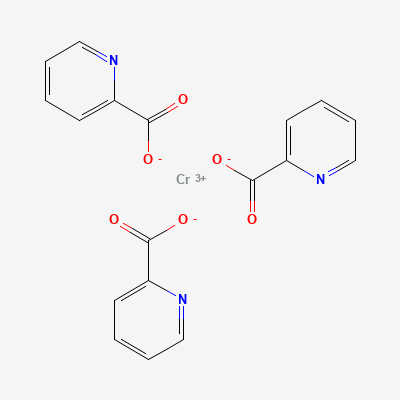
Chromium Picolinate
| Product Name | Chromium Picolinate |
|---|---|
| CAS Number | 14639-25-9 |
| Appearance | Deep red to reddish-brown crystalline powder |
| Specifications | ≥98.0% (HPLC) |
| Chromium Content | 12.0% – 12.5% |
| Loss on Drying | ≤0.5% |
| Heavy Metals | ≤10 ppm |
| Package | 25 kg fiber drum with double polyethylene liner |
Need help? Contact our team
Synonyms: Chromium(III) picolinate, Tris(picolinato)chromium, Chromium pyridine-2-carboxylate, Chromium tris(picolinate), CrPic
Chromium picolinate is a coordination complex in which a central chromium(III) ion is bound to three picolinic acid molecules. This chelated form was first synthesized in the 1960s, but its rise to prominence came in the 1980s when researchers identified it as a more bioavailable alternative to inorganic chromium salts. Today it is one of the most widely used chromium sources in dietary supplements, clinical nutrition, and functional food formulations.
The compound’s value lies in its ability to support insulin signaling. Chromium is an essential trace element that potentiates the action of insulin, and picolinic acid—a natural metabolite of tryptophan—acts as a chelating agent that improves absorption across the intestinal wall. Compared with chromium chloride or chromium polynicotinate, chromium picolinate offers superior stability and a higher degree of bioavailability, which explains its dominance in the sports nutrition and glucose management categories.
Commercial chromium picolinate is typically produced through a reaction between chromium(III) salts and picolinic acid under controlled pH and temperature. The resulting complex is isolated, purified, and milled to a fine powder that meets pharmacopeial standards. It is standardized to a chromium content of 12.0–12.5%, corresponding to a purity of ≥98.0% by HPLC.
| Parameter | Specification |
|---|---|
| Assay (HPLC) | ≥98.0% |
| Chromium Content | 12.0% – 12.5% |
| Identification | IR spectrum conforms to reference |
| Loss on Drying | ≤0.5% |
| Residue on Ignition | ≤0.2% |
| Heavy Metals | ≤10 ppm |
| Microbial Limits | Total plate count ≤1000 CFU/g; Yeast & mold ≤100 CFU/g; E. coli absent |
Room,5-0203, Unit 5, Beiyuanmen Street,Xi'an,Shaanxi,China
 English English
 Russian
 French
 Korean
 German
 Polish
 Japanese
 Spanish
 Italian
 Vietnamese