
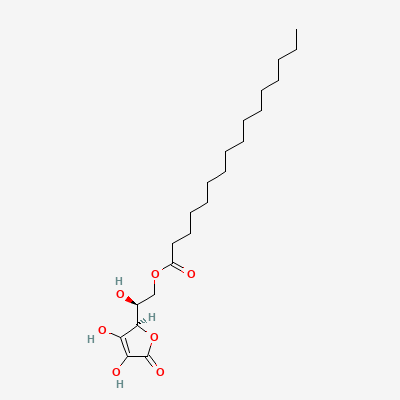
Ascorbyl Palmitate
| Product Name | Ascorbyl Palmitate |
|---|---|
| CAS Number | 137-66-6 |
| Other Names | Vitamin C palmitate, L-Ascorbyl palmitate, Ascorbic acid 6-palmitate |
| Molecular Formula | C22H38O7 |
| Molecular Weight | 414.54 g/mol |
| Appearance | White to off-white crystalline powder |
| Assay (HPLC) | ≥98.0% |
| Loss on Drying | ≤0.5% |
| Heavy Metals | ≤10 ppm |
| Solubility | Soluble in ethanol, propylene glycol; insoluble in water |
| Package | 25 kg fiber drum with inner polyethylene liner |
Need help? Contact our team
Synonyms: L-Ascorbyl palmitate, Ascorbic acid 6-palmitate, Vitamin C palmitate, 6-O-Palmitoyl-L-ascorbic acid, Ascorbyl palmitate
Ascorbyl palmitate is a fat-soluble derivative of L-ascorbic acid, formed by esterifying the primary hydroxyl group at the C-6 position with palmitic acid. This modification preserves the enediol lactone ring—the structural core responsible for vitamin C’s antioxidant capacity—while introducing a long aliphatic chain that dramatically alters its solubility profile. Unlike ascorbic acid, which is hydrophilic and readily degrades in aqueous environments, ascorbyl palmitate partitions into lipid phases, making it an effective antioxidant in oils, fats, and emulsified systems. The molecule retains the ability to donate hydrogen atoms from its enediol moiety, neutralizing free radicals and terminating chain oxidation reactions.
Commercially, ascorbyl palmitate is produced through enzymatic or chemical esterification of ascorbic acid with palmitic acid, followed by purification to yield a high-purity crystalline powder. It is available in food-grade, cosmetic-grade, and pharmaceutical-grade qualities, with assay specifications typically ≥98.0% by HPLC. The compound is widely used as an antioxidant in edible oils, infant formulas, and lipid-based nutraceuticals, as well as in topical formulations where it provides both antioxidant protection and skin-conditioning benefits. Its stability in non-aqueous environments and synergistic effect with tocopherols make it a preferred choice for extending the shelf life of sensitive lipid systems.
Beyond its role as a preservative, ascorbyl palmitate has attracted research interest for its potential to modulate collagen synthesis, inhibit tyrosinase activity, and protect cell membranes from oxidative damage. In pharmaceutical and cosmetic applications, it is often incorporated into liposomes or microemulsions to enhance dermal delivery. For formulators seeking a stable, oil-soluble vitamin C source, ascorbyl palmitate offers a practical balance of antioxidant efficacy, compatibility, and regulatory acceptance.
Ascorbyl palmitate consists of a lactone ring with two hydroxyl groups on the enediol moiety and a palmitoyl ester chain attached at the C-6 position. Its molecular formula is C22H38O7, with a molecular weight of 414.54 g/mol. The compound appears as a white to off-white crystalline powder, practically insoluble in water but freely soluble in ethanol, propylene glycol, and vegetable oils. The melting point typically ranges from 116–118°C. The presence of the long alkyl chain imparts lipophilic character, while the enediol group retains reducing properties, enabling it to act as a primary antioxidant in lipid media.
| Parameter | Specification |
|---|---|
| Appearance | White to off-white crystalline powder |
| Assay (HPLC) | ≥98.0% |
| Loss on Drying | ≤0.5% |
| Heavy Metals | ≤10 ppm |
| Residue on Ignition | ≤0.1% |
| Specific Rotation | +21° to +24° (c=1, ethanol) |
Room,5-0203, Unit 5, Beiyuanmen Street,Xi'an,Shaanxi,China
 English English
 Russian
 French
 Korean
 German
 Polish
 Japanese
 Spanish
 Italian
 Vietnamese