
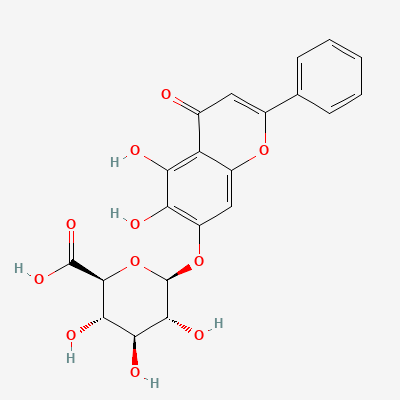
Baicalin
| Parametr | Specyfikacja |
|---|---|
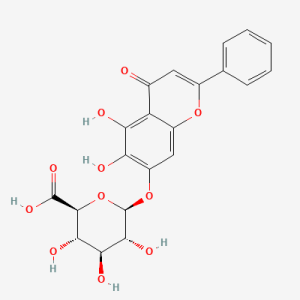
| Nazwa produktu | Baicalin |
| Numer CAS | 21967-41-9 |
| Wzór cząsteczkowy | C21H18O11 |
| Masa cząsteczkowa | 446.36 g/mol |
| Wygląd | Light yellow to yellow fine powder |
| Oznaczenie (HPLC) | ≥95% |
| Rozpuszczalność | Slightly soluble in water, soluble in methanol and ethanol |
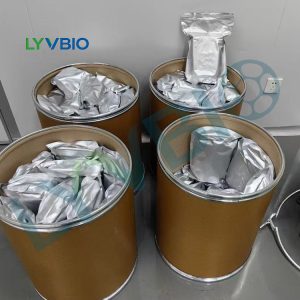
| Opakowanie | 1 kg / 5 kg / 25 kg drums |
Potrzebujesz pomocy? Skontaktuj się z naszym zespołem
Synonimy: Baicalin, Baicalein 7-glucuronide, 5,6-Dihydroxyflavone 7-glucuronide, Scutellaria baicalensis extract, Baical skullcap root extract, Huang Qin extract, Baicalin hydrate
Baicalin is a flavonoid glycoside extracted from the dried root of Scutellaria baicalensis, a plant widely cultivated in northern China. We supply it as a light yellow to yellow fine powder, standardized to ≥95% by HPLC, and it is a common choice for formulators who need a well-defined natural flavonoid rather than a broad-spectrum extract.
The ingredient sits in the high-purity segment of the flavonoid market. Its value lies in the baicalin content itself, which is why buyers specify an HPLC assay instead of a simple extract ratio. The powder dissolves readily in methanol and ethanol, and shows only slight solubility in water — a detail that matters when you are choosing a solvent system for a liquid or semi-solid formulation.
Capsule and tablet lines take most of the volume, but baicalin also appears in oral liquids, cosmetic serums and research reference standards. Because it is a single, well-characterized molecule rather than a mixed extract, it is easy to dose accurately and to label with a clear content figure.
Most baicalin goes into oral solid dosage forms — two-piece capsules, compressed tablets and stick packs — where it is used alone or combined with other flavonoids such as quercetin and luteolin. Formulators value it for its clean analytical profile: a single peak on HPLC makes batch-to-batch verification straightforward, and the powder blends well with common excipients like microcrystalline cellulose and magnesium stearate.
In cosmetics, baicalin is incorporated into serums, creams and masks, typically at low percentages, where it is compatible with both oil-in-water and water-in-oil systems. It also serves as a reference standard in analytical laboratories and as a starting material for baicalein production. For beverage or liquid formats, the limited water solubility usually calls for a cosolvent or a solubilized grade, so it is worth discussing the intended vehicle before you finalize the specification.
Our baicalin is produced from the dried root of Scutellaria baicalensis, harvested in China. The root is extracted with water or aqueous alcohol, and the crude extract is then purified through a series of separation steps to isolate the baicalin fraction. The final product is crystallized, dried and milled to a fine powder, then assayed by HPLC before release.
We keep both high-purity (≥95%) and lower-assay grades in stock, so you can match the specification to your application without overpaying for purity you do not need. Each lot is traceable back to the extraction batch.
send us your specification for a quotation.
Room,5-0203, Unit 5, Beiyuanmen Street,Xi'an,Shaanxi,China
 English English
 Russian
 French
 Korean
 German
 Polish
 Japanese
 Spanish
 Italian
 Vietnamese