
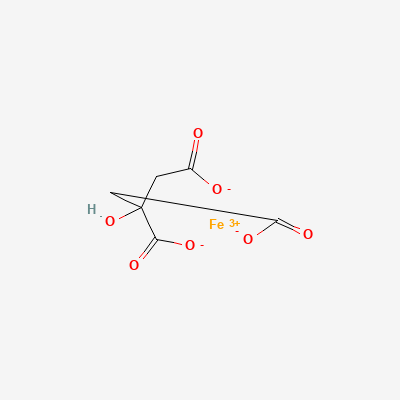
FERRIC CITRATE
| 제품명 | Ferric Citrate |
|---|---|
| CAS 번호 | 2338-05-8 |
| 분자식 | C6H5FeO7 |
| 분자량 | 244.94 g/mol |
| 외관 | Reddish-brown to amber powder or granules |
| Assay | ≥ 97.0% (as iron citrate, dried basis) |
| Iron Content | 16.5–18.5% |
| 용해도 | Soluble in water, practically insoluble in ethanol |
| 건조 손실 | ≤ 5.0% |
| 패키지 | 25 kg fiber drum with two PE liners |
도움이 필요하신가요? 저희 팀에 문의해 주세요
Synonyms: Iron(III) citrate, Ferric citrate, 2-Hydroxy-1,2,3-propanetricarboxylic acid iron(3+) salt, Citric acid iron(III) salt, Iron citrate
Ferric citrate is the iron(III) salt of citric acid, in which three carboxylate groups of the citrate ligand coordinate to a central ferric ion, forming a stable, water-soluble complex. This chelation shields the iron from premature precipitation in the gastrointestinal tract, allowing for efficient delivery and absorption. The citrate backbone also participates in cellular energy metabolism, making the compound well tolerated and bioavailable.
Industrially, ferric citrate is produced by reacting ferric hydroxide or ferric chloride with citric acid under controlled pH and temperature, followed by spray drying or granulation. It appears as a reddish-brown to amber powder with a faint acidic odor, freely soluble in water but practically insoluble in ethanol. The compound is amphoteric and exhibits pH-dependent solubility, which influences its behavior in formulations.
Ferric citrate is primarily used as a phosphate binder in patients with chronic kidney disease (CKD) and as an iron supplement for iron deficiency anemia. In the pharmaceutical and nutraceutical industries, it serves as a source of bioavailable iron in oral dosage forms. Additionally, it finds application in food fortification, where it provides iron without undesirable color or flavor changes. Its dual role as a phosphate binder and iron donor makes it a valuable active ingredient in nephrology and hematology.
Ferric citrate consists of a ferric ion (Fe3+) coordinated by citrate ligands, typically forming a polymeric or oligomeric structure in aqueous solution. The citrate moiety acts as a tridentate ligand, binding through its central hydroxyl and two terminal carboxylate groups. This chelation results in a stable complex with a formation constant high enough to prevent hydrolysis at physiological pH. The compound is highly soluble in water, yielding a colloidal solution that is stable under acidic to neutral conditions. Its redox behavior is influenced by the citrate environment, which moderates the reactivity of the ferric ion.
| 매개변수 | 사양 |
|---|---|
| Assay (as iron citrate) | ≥ 97.0% |
| Iron content | 16.5–18.5% |
| Loss on drying | ≤ 5.0% |
| Heavy metals | 10 ppm 이하 |
| Arsenic | ≤ 2 ppm |
| Lead | ≤ 2 ppm |
| Microbial limits | Total aerobic count ≤ 1000 CFU/g, Yeast & mold ≤ 100 CFU/g, E. coli absent |
 English English
 Russian
 French
 Korean
 German
 Polish
 Japanese
 Spanish
 Italian
 Vietnamese