
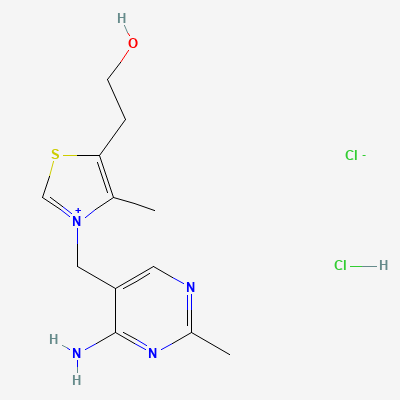
Thiamine hydrochloride
| 製品名 | Thiamine hydrochloride |
|---|---|
| CAS番号 | 67-03-8 |
| 分子式 | C12H17ClN4OS·HCl |
| 分子量 | 337.27 g/mol |
| 外観 | White or almost white crystalline powder |
| Assay (on dried basis) | 98.5% – 101.0% |
| 乾燥減量 | ≤ 5.0% |
| 焼失残渣 | ≤ 0.1% |
| 重金属 | ≤ 20 ppm |
| 溶解度 | Freely soluble in water, slightly soluble in ethanol, practically insoluble in ether |
| pH(1%溶液) | 2.7 – 3.4 |
| パッケージ | 25 kg fiber drum with double polyethylene liner |
お困りですか? 弊社チームまでお問い合わせください
Synonyms: Vitamin B1 hydrochloride, Aneurine hydrochloride, Thiamine chloride hydrochloride, 3-[(4-Amino-2-methyl-5-pyrimidinyl)methyl]-5-(2-hydroxyethyl)-4-methylthiazolium chloride hydrochloride, Thiamine HCl
Thiamine hydrochloride is the synthetic hydrochloride salt of thiamine (vitamin B1), a water-soluble vitamin built on a pyrimidine–thiazolium core. The molecule consists of a 4-amino-2-methylpyrimidine ring linked by a methylene bridge to a 5-(2-hydroxyethyl)-4-methylthiazolium ring, with the thiazolium nitrogen carrying a positive charge balanced by chloride. This structural arrangement is not incidental—the thiazolium C2 proton is acidic enough to form the ylide that anchors thiamine’s catalytic role in carbohydrate metabolism. As a coenzyme (thiamine pyrophosphate, TPP), it drives decarboxylation of α-keto acids and transketolase reactions in the pentose phosphate pathway.
Commercial thiamine hydrochloride is produced by chemical synthesis, typically starting from pyrimidine and thiazole precursors that are coupled and then converted to the hydrochloride salt. It appears as a white or almost white crystalline powder, freely soluble in water and slightly soluble in ethanol, with a characteristic yeast-like odor and a bitter taste. The hydrochloride form is the most common solid dosage form because of its high water solubility and stability under normal storage conditions. It is available in multiple grades: USP/EP/BP for pharmaceutical use, food grade (FCC) for fortification, and technical grade for feed and industrial applications.
In practice, thiamine hydrochloride is used across a broad range of products—from injectables and oral tablets to infant formula, energy drinks, and animal feed premixes. It is also a standard reagent in biochemical research, particularly in studies of oxidative decarboxylation and transketolase activity. Because thiamine is not stored in the body to any significant extent, consistent intake or supplementation is necessary, which keeps demand steady in clinical nutrition and public health programs.
Thiamine hydrochloride has a molecular weight of 337.27 g/mol and is highly polar due to the quaternary thiazolium nitrogen and the primary amino group. The positive charge on the thiazolium ring makes the compound freely soluble in water (about 1 g/mL) but practically insoluble in nonpolar solvents. The hydrochloride salt is stable in dry form, but in aqueous solution it is sensitive to light, heat, and alkaline pH, where the thiazolium ring opens and activity is lost. The C2 hydrogen on the thiazolium ring is unusually acidic (pKa ~ 18), a property central to its coenzyme function. Thiamine hydrochloride melts with decomposition around 250°C, and its solid-state stability is good when kept below 25°C and protected from moisture.
| パラメータ | 仕様 |
|---|---|
| 外観 | White or almost white crystalline powder |
| Assay (on dried basis) | 98.5% – 101.0% |
| 乾燥減量 | ≤ 5.0% |
| 焼失残渣 | ≤ 0.1% |
| 重金属 | ≤ 20 ppm |
| pH(1%溶液) | 2.7 – 3.4 |
 English English
 Russian
 French
 Korean
 German
 Polish
 Japanese
 Spanish
 Italian
 Vietnamese