
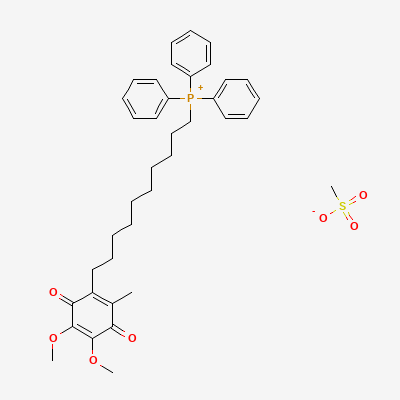
Mésylate de mitoquinone
| Nom du produit | Mésylate de mitoquinone |
|---|---|
| Numéro CAS | 845959-50-4 |
| Synonymes | MitoQ, Mitoquinol mesylate, Mitoquinone mesylate, (10-(4,5-Dimethoxy-2-methyl-3,6-dioxo-1,4-cyclohexadien-1-yl)decyl)triphenylphosphonium mesylate |
| Formule moléculaire | C38H47O7PS (mesylate salt) |
| Poids moléculaire | 678.82 g/mol (free base: 583.75 g/mol) |
| Apparence | Orange to red crystalline powder |
| Essai (HPLC) | ≥98,01 TP3T |
| Solubilité | Soluble in DMSO, ethanol, methanol; slightly soluble in water |
| Perte au séchage | ≤ 1,01 TP3T |
| Métaux lourds | ≤ 10 ppm |
| Stockage | Store at -20°C, protected from light and moisture |
| Colis | 10 mg, 50 mg, 100 mg, 500 mg, 1 g in amber glass vials |
Besoin d'aide ? Contacter notre équipe
Synonymes : MitoQ, Mitoquinol mesylate, Mitoquinone mesylate, (10-(4,5-Dimethoxy-2-methyl-3,6-dioxo-1,4-cyclohexadien-1-yl)decyl)triphenylphosphonium mesylate
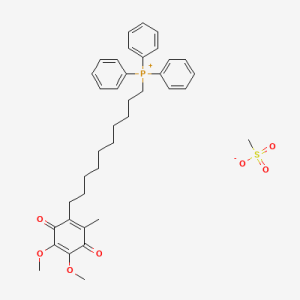
Mitoquinone mesylate is a synthetic derivative of coenzyme Q10 (ubiquinone) engineered to accumulate within mitochondria. Its structure couples a quinone redox core to a ten-carbon aliphatic chain terminated by a triphenylphosphonium (TPP+) cation. This lipophilic cation drives rapid electrophoretic uptake across the mitochondrial inner membrane, where the membrane potential (Δψm) is highly negative. The result is a mitochondria-targeted antioxidant that concentrates several hundred-fold inside the organelle, far exceeding the distribution of native CoQ10.
As a research chemical, Mitoquinone mesylate is supplied as the mesylate salt to improve aqueous solubility and handling stability. It is widely used in cellular and animal models to interrogate mitochondrial oxidative stress, redox signaling, and bioenergetics. Typical applications include studies on aging, neurodegeneration, cardiovascular ischemia-reperfusion injury, and metabolic disorders.
In the pharmaceutical and nutraceutical supply chain, Mitoquinone mesylate is recognized as a high-value active pharmaceutical ingredient (API) candidate and a reference standard for analytical method development. Its synthesis involves a multi-step route that demands strict control over purity, residual solvents, and counterion stoichiometry. LyvBio provides Mitoquinone mesylate with full analytical documentation, supporting formulation development and preclinical research.
The molecule consists of a 2,3-dimethoxy-5-methyl-1,4-benzoquinone headgroup linked via a decyl chain to a triphenylphosphonium moiety. The mesylate counterion (CH3SO3–) balances the positive charge, yielding a crystalline solid with improved water dispersibility compared to the free base. The compound is sensitive to light and reducing agents; storage under inert gas at low temperature is recommended to prevent quinone reduction or degradation.
| Paramètre | Spécifications |
|---|---|
| Apparence | Orange to red crystalline powder |
| Essai (HPLC) | ≥98,01 TP3T |
| Identification (NMR, MS) | Conforms to structure |
| Perte au séchage | ≤ 1,01 TP3T |
| Métaux lourds | ≤ 10 ppm |
| Solvants résiduels | Meets ICH Q3C limits |
| Limites microbiologiques | Total aerobic count ≤1000 CFU/g; no pathogens |
Room,5-0203, Unit 5, Beiyuanmen Street,Xi'an,Shaanxi,China
 English English
 Russian
 French
 Korean
 German
 Polish
 Japanese
 Spanish
 Italian
 Vietnamese