
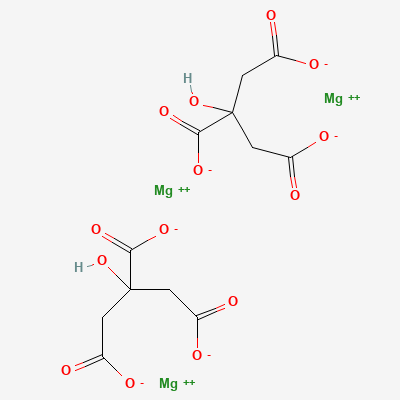
Magnesium Citrate
| Nom du produit | Magnesium Citrate |
|---|---|
| Numéro CAS | 7779-25-1 |
| Formule moléculaire | C12H10Mg3O14 |
| Poids moléculaire | 451.11 g/mol |
| Apparence | White crystalline powder |
| Assay | ≥98.0% (on dried basis) |
| Perte au séchage | ≤5,01 TP3T |
| Métaux lourds | ≤ 10 ppm |
| Solubilité | Soluble dans l'eau, pratiquement insoluble dans l'éthanol |
| Granulométrie | ≥98% through 80 mesh |
| Colis | 25 kg net paper bag with PE inner liner |
Besoin d'aide ? Contacter notre équipe
Synonymes : Magnesium citrate tribasic, Trimagnesium citrate, Magnesium salt of citric acid, Citric acid magnesium salt, E345
Magnesium citrate has become a staple in the dietary supplement aisle, driven by growing consumer awareness of magnesium deficiency and its role in everything from muscle recovery to sleep quality. Formulators favor it for its high bioavailability and gentle gastrointestinal profile, making it a go-to choice for capsules, powders, and effervescent tablets.
Chemically, it is the magnesium salt of citric acid, typically existing as a hydrated form such as the nonahydrate. It is produced by reacting magnesium oxide or hydroxide with citric acid in aqueous solution, followed by crystallization and drying. The result is a white, water-soluble powder with a mild taste, ideal for drink mixes and functional beverages.
Commercial grades are standardized to ≥98% magnesium citrate, with tight control on heavy metals and microbial limits. Its excellent solubility and neutral pH in solution make it compatible with a wide range of actives, from vitamin D to probiotics, without compromising stability.
Magnesium citrate consists of magnesium cations chelated with citrate anions. The citrate moiety itself contributes to the mineral’s bioavailability by enhancing absorption through the intestinal epithelium. The compound is available in anhydrous, dihydrate, and nonahydrate forms, with the nonahydrate being the most common for supplement applications due to its stability and ease of handling.
In terms of elemental magnesium content, the nonahydrate provides approximately 11.3% magnesium, while the anhydrous form offers around 16.2%. This variation allows formulators to adjust dosages precisely based on the desired elemental magnesium delivery. The citrate anion also acts as a mild buffer, which can help reduce gastric irritation often associated with other magnesium salts like oxide or sulfate.
| Paramètre | Spécifications |
|---|---|
| Assay | ≥98,01 TP3T |
| Perte au séchage | ≤5,01 TP3T |
| Métaux lourds | ≤ 10 ppm |
| Arsenic | ≤2 ppm |
| Limites microbiologiques | Total plate count ≤1000 cfu/g; Yeast & Mold ≤100 cfu/g; E. coli absent |
Room,5-0203, Unit 5, Beiyuanmen Street,Xi'an,Shaanxi,China
 English English
 Russian
 French
 Korean
 German
 Polish
 Japanese
 Spanish
 Italian
 Vietnamese