
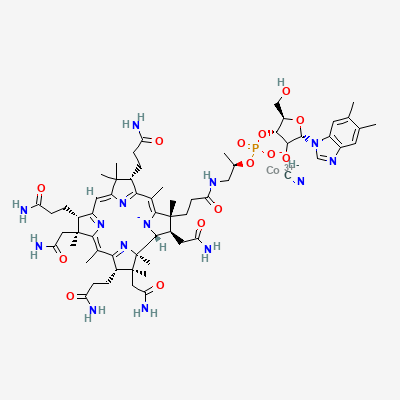
Vitamin B12
| Produktname | Vitamin B12 |
|---|---|
| Andere Bezeichnungen | Cyanocobalamin, Cobalamin, Cobalamine, Vitamin B-12, Cyanocob(III)alamin |
| CAS-Nummer | 68-19-9 |
| Molekülformel | C63H88CoN14O14P |
| Molekulargewicht | 1355.37 g/mol |
| Aussehen | Dark red crystalline powder or crystals |
| Assay | ≥98.0% (HPLC) / ≥99.0% (USP) |
| Trocknungsverlust | ≤12.0% |
| Schwermetalle | ≤20 ppm |
| Löslichkeit | Slightly soluble in water, soluble in ethanol, practically insoluble in acetone |
| Verpackung | 1 kg, 5 kg, 25 kg fiber drums with food-grade liners |
Brauchst du Hilfe? Kontaktieren Sie unser Team
Synonyms: Cyanocobalamin, Cobalamin, Vitamin B-12, Cyanocob(III)alamin, Cobalamine, Antipernicious anemia factor
Vitamin B12, also known as cyanocobalamin, is a water-soluble vitamin belonging to the cobalamin family. Its structure features a central cobalt ion coordinated within a corrin ring, making it the largest and most complex of all vitamins. First isolated in 1948 from liver extracts as the anti-pernicious anemia factor, it has since become indispensable in clinical nutrition, pharmaceutical formulations, and food fortification. In the body, Vitamin B12 serves as a cofactor for methionine synthase and methylmalonyl-CoA mutase, enzymes critical for DNA synthesis, red blood cell formation, and neurological function.
Among the cobalamins, cyanocobalamin is the most stable and widely used form in supplements and fortified foods. It is readily converted to the active coenzyme forms, methylcobalamin and adenosylcobalamin, after ingestion. Its distinctive dark red color arises from the cobalt-corrin complex, and its stability in solid form and neutral solutions makes it the preferred choice for tableting, encapsulation, and liquid formulations. Vitamin B12 is unique among vitamins in that it is synthesized exclusively by microorganisms; no plant or animal can produce it de novo, which is why deficiency is common among vegans and the elderly.
Commercial Vitamin B12 is produced through fermentation using selected strains of Propionibacterium shermanii or Pseudomonas denitrificans, followed by purification and conversion to cyanocobalamin. It is standardized to ≥98% purity (HPLC) or meets USP/EP monographs, ensuring consistent potency for pharmaceutical and nutraceutical applications. Beyond its classic role in treating pernicious anemia, Vitamin B12 is used in energy metabolism, homocysteine regulation, and neuroprotection, and is a key ingredient in multivitamin preparations, energy drinks, and parenteral nutrition.
| Parameter | Technische Daten |
|---|---|
| Assay | ≥98,01 % TP3T (HPLC) |
| Identification | IR, UV, or HPLC retention time matches standard |
| Trocknungsverlust | ≤12.0% |
| Verbrennungsrückstand | ≤0,1% |
| Schwermetalle | ≤20 ppm |
| Microbial Limits | Total aerobic count ≤1000 CFU/g; Yeast & Mold ≤100 CFU/g; E. coli absent |
Room,5-0203, Unit 5, Beiyuanmen Street,Xi'an,Shaanxi,China
 English English
 Russian
 French
 Korean
 German
 Polish
 Japanese
 Spanish
 Italian
 Vietnamese