
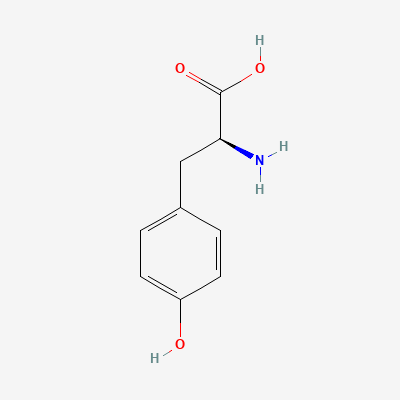
L-Tyrosine
| Produktname | L-Tyrosine |
|---|---|
| CAS-Nummer | 60-18-4 |
| Aussehen | Weißes bis cremefarbenes kristallines Pulver |
| Technische Daten | ≥99,01 TP3T (HPLC) |
| Molekülformel | C9H11NO3 |
| Molekulargewicht | 181.19 g/mol |
| Löslichkeit | Sparingly soluble in water; soluble in aqueous acid and alkali |
| Trocknungsverlust | ≤0,5% |
| Verbrennungsrückstand | ≤0,1% |
| Schwermetalle | ≤ 10 ppm |
| Verpackung | 25 kg fiber drum with double polyethylene liner |
Brauchst du Hilfe? Kontaktieren Sie unser Team
Synonyme: L-2-Amino-3-(4-hydroxyphenyl)propionic acid, (S)-2-Amino-3-(4-hydroxyphenyl)propanoic acid, L-p-Hydroxyphenylalanine, p-Tyrosine, (S)-Tyrosine
L-Tyrosine is a non-essential amino acid with a phenolic side chain, derived from phenylalanine through the action of phenylalanine hydroxylase. This hydroxylation step is critical for its biological activity, as the para-hydroxyl group enables hydrogen bonding and serves as a site for further enzymatic modifications. As a precursor to catecholamines (dopamine, norepinephrine, epinephrine), thyroid hormones (thyroxine, triiodothyronine), and the pigment melanin, L-Tyrosine is central to neuroendocrine signaling and metabolic regulation. Its structure features a chiral α-carbon, and only the L-isomer is biologically active in mammalian systems.
Commercially, L-Tyrosine is produced via enzymatic resolution or microbial fermentation, yielding high-purity material suitable for pharmaceutical, nutraceutical, and cell culture applications. It is available in various grades, including USP, EP, and food-grade, with strict control over enantiomeric purity and residual solvents. The compound appears as a white crystalline powder, sparingly soluble in water but freely soluble in acidic or alkaline solutions due to its zwitterionic nature.
In the pharmaceutical industry, L-Tyrosine serves as a key intermediate in the synthesis of levodopa (L-DOPA) and other catecholamine-based drugs. In nutraceuticals, it is incorporated into formulations aimed at cognitive support, stress management, and athletic performance, based on its role in neurotransmitter synthesis. Additionally, it is used in cell culture media and as a chiral building block in asymmetric synthesis. Its versatility and well-documented safety profile make it a staple in both research and industrial settings.
L-Tyrosine belongs to the aromatic amino acid family, characterized by a benzene ring bearing a hydroxyl group at the para position relative to the alanine side chain. The molecule exists as a zwitterion at physiological pH, with the carboxyl group deprotonated (pKa1 = 2.20) and the amino group protonated (pKa2 = 9.11); the phenolic hydroxyl has a pKa of 10.07. This amphoteric nature underlies its solubility profile and its behavior in ion-exchange chromatography. The aromatic ring contributes to UV absorbance at 274 nm, facilitating analytical detection. L-Tyrosine is optically active, with a specific rotation of -10.0° to -12.0° (c=5, 1M HCl), and is essentially insoluble in ethanol and ether.
| Parameter | Technische Daten |
|---|---|
| Analyse (HPLC) | ≥99.0% |
| Aussehen | Weißes bis cremefarbenes kristallines Pulver |
| Identification | IR, HPLC retention time conforms to standard |
| Specific Rotation | -10.0° to -12.0° (c=5, 1M HCl) |
| Trocknungsverlust | ≤0,5% |
| Verbrennungsrückstand | ≤0,1% |
| Schwermetalle | ≤ 10 ppm |
Room,5-0203, Unit 5, Beiyuanmen Street,Xi'an,Shaanxi,China
 English English
 Russian
 French
 Korean
 German
 Polish
 Japanese
 Spanish
 Italian
 Vietnamese