

Galantamine Hydrobromide
| Produktname | Galantamine Hydrobromide |
|---|---|
| CAS-Nummer | 1953-04-4 |
| Aussehen | Weißes bis cremefarbenes kristallines Pulver |
| Technische Daten | ≥98,01 % TP3T (HPLC) |
| Molekülformel | C17H22BrNO3 |
| Molekulargewicht | 368.27 g/mol |
| Löslichkeit | Soluble in water, ethanol; slightly soluble in acetone |
| Verpackung | 25 kg fiber drum, inner polyethylene bags |
Brauchst du Hilfe? Kontaktieren Sie unser Team
Synonyme: Galantamine hydrobromide, (4aS,6R,8aS)-4a,5,9,10,11,12-Hexahydro-3-methoxy-11-methyl-6H-benzofuro[3a,3,2-ef][2]benzazepin-6-ol hydrobromide, Galanthamine hydrobromide, Lycoremine hydrobromide, Nivalin, Razadyne
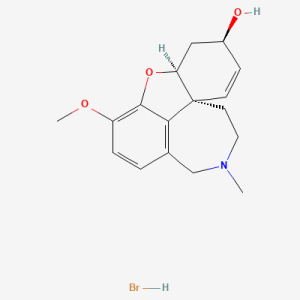
Galantamine hydrobromide is a tertiary alkaloid salt derived from the Amaryllidaceae family, structurally characterized by a benzofuro[3a,3,2-ef][2]benzazepine core with a methoxy substituent at C3 and a hydroxyl group at C6. This unique framework distinguishes it from other cholinesterase inhibitors and underpins its dual mechanism of action—both as a reversible acetylcholinesterase inhibitor and a positive allosteric modulator of nicotinic acetylcholine receptors. The hydrobromide salt enhances aqueous solubility and stability, making it the preferred form for pharmaceutical formulations.
Originally isolated from snowdrop (Galanthus woronowii) and daffodil (Narcissus pseudonarcissus) bulbs, galantamine has transitioned from a natural product to a synthetically accessible active pharmaceutical ingredient (API). Today, commercial production relies on optimized semi-synthetic or fully synthetic routes, ensuring high purity and consistent supply. The compound is typically available as a white to off-white crystalline powder, with a purity of ≥98.0% as determined by HPLC. It is freely soluble in water and ethanol, facilitating formulation into oral dosage forms such as tablets, capsules, and oral solutions.
In the pharmaceutical industry, galantamine hydrobromide is primarily indicated for mild to moderate Alzheimer’s disease, where it improves cognitive function and global clinical status. Beyond its established use, ongoing research explores its potential in other neurological conditions, including vascular dementia, schizophrenia, and autism spectrum disorders. Its ability to modulate nicotinic receptors also attracts interest in smoking cessation and alcohol dependence therapies. For B2B customers, LyvBio supplies galantamine hydrobromide under strict quality control, supported by comprehensive documentation and reliable logistics.
Galantamine hydrobromide belongs to the Amaryllidaceae alkaloid class, featuring a fused tetracyclic skeleton that includes a benzofuran ring. The C3 methoxy group and C6 hydroxyl are critical for its interaction with cholinesterase enzymes and nicotinic receptors. The hydrobromide salt form is obtained by reacting the free base with hydrobromic acid, yielding a stable, crystalline solid with a molecular weight of 368.27 g/mol. It exhibits good thermal stability under recommended storage conditions (2–8°C, protected from light and moisture). The compound’s solubility profile supports both immediate-release and sustained-release formulations, and its chiral centers necessitate stereoselective synthesis or resolution to ensure enantiomeric purity.
| Parameter | Technische Daten |
|---|---|
| Assay (HPLC, on dried basis) | ≥98,01 TP3T |
| Identification | IR, HPLC retention time conforms to standard |
| Aussehen | Weißes bis cremefarbenes kristallines Pulver |
| Trocknungsverlust | ≤0,5% |
| Verbrennungsrückstand | ≤0,1% |
| Schwermetalle | ≤ 10 ppm |
| Related Substances | Total impurities ≤1.0% |
Room,5-0203, Unit 5, Beiyuanmen Street,Xi'an,Shaanxi,China
 English English
 Russian
 French
 Korean
 German
 Polish
 Japanese
 Spanish
 Italian
 Vietnamese