
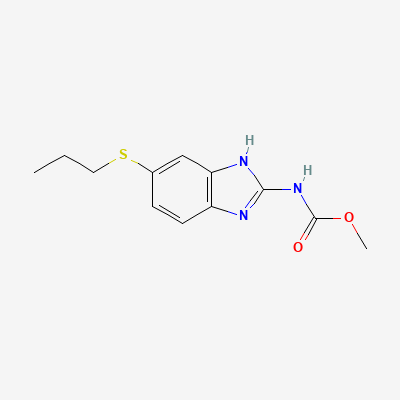
Albendazole
| Produktname | Albendazole |
|---|---|
| CAS-Nummer | 54965-21-8 |
| Molekülformel | C12H15N3O2S |
| Molekulargewicht | 265.33 g/mol |
| Aussehen | Weißes bis cremefarbenes kristallines Pulver |
| Technische Daten | ≥98% (HPLC) |
| Löslichkeit | Slightly soluble in water, freely soluble in dimethyl sulfoxide, sparingly soluble in methanol |
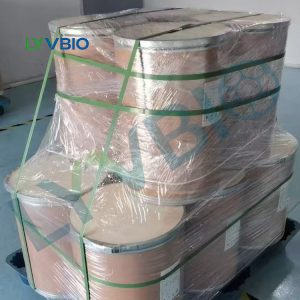
| Verpackung | 25 kg fiber drum with double polyethylene liner |
| Technische Daten | 98% |
Brauchst du Hilfe? Kontaktieren Sie unser Team
Synonyme: Albendazole, 54965-21-8, Methyl 5-(propylthio)-2-benzimidazolecarbamate, Albendazolum, Zentel, Albenza, Eskazole
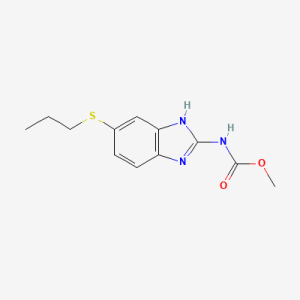
Albendazole is a synthetic benzimidazole derivative that acts as a broad-spectrum anthelmintic. Its molecular structure features a benzimidazole core with a propylthio side chain and a methyl carbamate group, which is essential for its interaction with β-tubulin. By binding to β-tubulin, albendazole inhibits microtubule polymerization, disrupting the cytoskeleton and leading to impaired glucose uptake and eventual parasite death. This mechanism is effective against a wide range of nematodes, cestodes, and trematodes.
Originally developed for veterinary use, albendazole has become a cornerstone in human medicine for treating soil-transmitted helminthiases, neurocysticercosis, and hydatid disease. It is included in the WHO Model List of Essential Medicines. The compound is poorly water-soluble, which poses formulation challenges; thus, various strategies such as micronization, solid dispersions, and lipid-based delivery systems are employed to enhance its bioavailability.
In pharmaceutical manufacturing, albendazole is typically produced in polymorphic forms, with Form I and Form II being the most common. The choice of polymorph can influence dissolution rate and, consequently, therapeutic efficacy. Our albendazole is manufactured under cGMP conditions and meets or exceeds the requirements of the current European Pharmacopoeia and United States Pharmacopeia. It is available with a purity of ≥98% (HPLC), ensuring consistent quality for both human and veterinary drug production.
Albendazole belongs to the benzimidazole class, characterized by a bicyclic system fused with an imidazole ring. The presence of the propylthio group enhances its lipophilicity, while the carbamate moiety contributes to its anthelmintic activity. The compound exists as a white to off-white crystalline powder, with a melting point range of 208–210°C (decomposition). It is practically insoluble in water but shows good solubility in aprotic polar solvents like dimethyl sulfoxide and dimethylformamide. Its logP value is approximately 3.5, indicating moderate lipophilicity, which facilitates membrane permeability in target organisms.
| Parameter | Technische Daten |
|---|---|
| Aussehen | Weißes bis cremefarbenes kristallines Pulver |
| Identification | IR spectrum conforms to reference standard |
| Analyse (HPLC) | ≥98.0% (on dried basis) |
| Trocknungsverlust | ≤0,5% |
| Verbrennungsrückstand | ≤0.2% |
| Schwermetalle | ≤20 ppm |
| Related Substances | Total impurities ≤2.0% |
Room,5-0203, Unit 5, Beiyuanmen Street,Xi'an,Shaanxi,China
 English English
 Russian
 French
 Korean
 German
 Polish
 Japanese
 Spanish
 Italian
 Vietnamese