
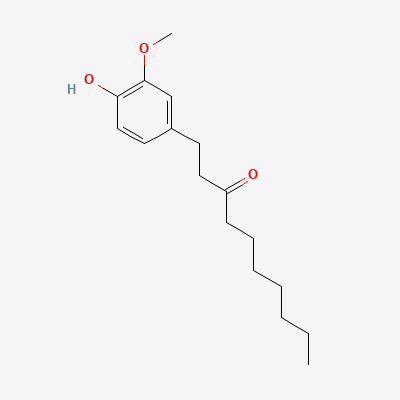
6-Paradol
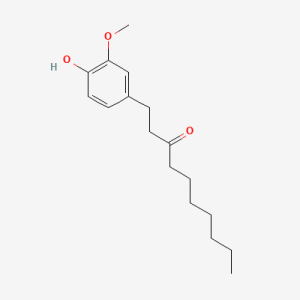
| Produktname | 6-Paradol |
|---|---|
| CAS-Nummer | 27113-22-0 |
| Andere Bezeichnungen | 1-(4-Hydroxy-3-methoxyphenyl)decan-3-one; 6-Gingerol analog; Dehydro-6-gingerol |
| Molekülformel | C17H26O3 |
| Molekulargewicht | 278.39 g/mol |
| Aussehen | Weißes bis cremefarbenes kristallines Pulver |
| Analyse (HPLC) | ≥98,01 TP3T |
| Trocknungsverlust | ≤0,5% |
| Verbrennungsrückstand | ≤0,1% |
| Schwermetalle | ≤ 10 ppm |
| Löslichkeit | Soluble in ethanol, DMSO, and dimethyl formamide; practically insoluble in water |
| Particle Size | 95% through 80 mesh |
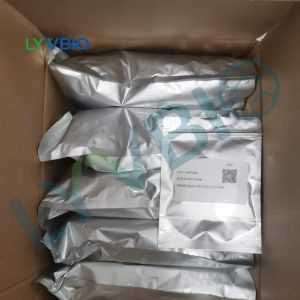
| Verpackung | 1 kg aluminum foil bag, 25 kg fiber drum |
Brauchst du Hilfe? Kontaktieren Sie unser Team
Synonyme: 6-Paradol, 1-(4-Hydroxy-3-methoxyphenyl)decan-3-one, 6-Gingerol analog, Dehydro-6-gingerol, [6]-Paradol
6-Paradol is a naturally occurring phenolic ketone that shares the same 4-hydroxy-3-methoxyphenyl (vanillyl) core as the gingerols, but with a shorter, unsaturated alkyl chain. This structural twist gives it a distinct pharmacological profile—most notably, a higher lipophilicity and a stronger interaction with transient receptor potential vanilloid 1 (TRPV1) channels. The compound is not just a minor ginger constituent; it is a key active in grains of paradise (Aframomum melegueta) and has become a molecule of interest for its metabolic and sensory properties.
Chemically, 6-paradol is the dehydro analog of 6-gingerol, lacking the β-hydroxy ketone moiety. It is typically obtained through extraction from Aframomum melegueta seeds or by semi-synthesis from 6-gingerol. The commercial material is standardized to ≥98% purity (HPLC) and appears as a white to off-white crystalline powder. Unlike many botanical extracts that are sold as complex mixtures, 6-paradol is offered as a single, well-defined entity, which makes it particularly attractive for mechanistic studies and product development where batch-to-batch consistency is critical.
In the B2B space, 6-paradol is finding traction in two main areas: as a bioactive in metabolic health supplements and as a thermogenic agent in sports nutrition. It also serves as a reference standard for analytical labs and as a starting material for synthetic derivatives. Its ability to modulate energy expenditure and lipid metabolism without the pungency associated with capsaicin makes it a compelling candidate for formulations targeting weight management and metabolic syndrome.
6-Paradol features a vanillyl group linked to a decanone chain with a trans-double bond at the C6 position. This α,β-unsaturated ketone is responsible for its reactivity and its interaction with TRPV1. The compound has a molecular weight of 278.39 g/mol and a melting point typically reported between 55–58 °C. It is soluble in most organic solvents but has poor aqueous solubility, a factor that formulators must address when developing water-based delivery systems. The presence of the phenolic hydroxyl also allows for antioxidant activity, though it is less pronounced than that of curcumin or resveratrol.
| Parameter | Technische Daten |
|---|---|
| Aussehen | Weißes bis cremefarbenes kristallines Pulver |
| Analyse (HPLC) | ≥98,01 TP3T |
| Trocknungsverlust | ≤0,5% |
| Verbrennungsrückstand | ≤0,1% |
| Schwermetalle | ≤ 10 ppm |
| Löslichkeit | Soluble in ethanol, DMSO; insoluble in water |
Room,5-0203, Unit 5, Beiyuanmen Street,Xi'an,Shaanxi,China
 English English
 Russian
 French
 Korean
 German
 Polish
 Japanese
 Spanish
 Italian
 Vietnamese