
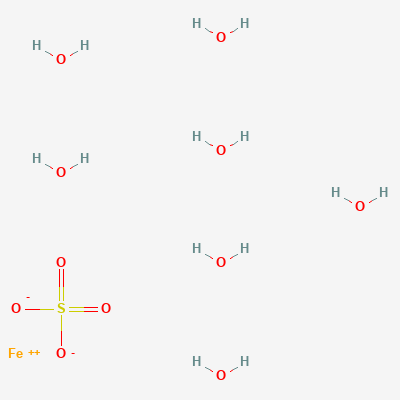
Ferrous sulfate heptahydrate
| Product Name | Ferrous sulfate heptahydrate |
|---|---|
| CAS Number | 7782-63-0 |
| Other Names | Iron(II) sulfate heptahydrate; Green vitriol; Copperas |
| Molecular Formula | FeSO4·7H2O |
| Molecular Weight | 278.01 g/mol |
| Appearance | Pale blue-green crystalline solid |
| Assay (FeSO4·7H2O) | ≥ 99.0% |
| Iron Content | 20.0–20.5% |
| Loss on Drying | ≤ 0.5% |
| Heavy Metals | ≤ 10 ppm |
| Solubility | Soluble in water (25 g/100 mL at 20°C), insoluble in ethanol |
| Package | 25 kg net multi-wall paper bags with PE liner, or 1000 kg jumbo bags |
Need help? Contact our team
Synonyms: Ferrous sulfate heptahydrate, Iron(II) sulfate heptahydrate, Green vitriol, Copperas, Iron vitriol, FeSO4·7H2O, CAS 7782-63-0
Ferrous sulfate heptahydrate is the most common hydrated form of iron(II) sulfate, a pale blue-green crystalline solid that has been known since antiquity as green vitriol. It occurs naturally as the mineral melanterite and is produced on a large scale as a by-product of titanium dioxide manufacturing and steel pickling. The heptahydrate is the stable form under ambient conditions, containing seven molecules of water of crystallization. Historically, it served as a source of iron for ink making, water purification, and as a mordant in dyeing, roles that still find modern relevance.
Chemically, ferrous sulfate heptahydrate consists of Fe2+ ions coordinated with sulfate and water molecules. The iron is in the +2 oxidation state, which is essential for its bioavailability and reactivity. Upon heating, it loses water stepwise, turning white as the heptahydrate converts to the monohydrate and then anhydrous form. In aqueous solution, it readily oxidizes to ferric sulfate, especially in the presence of air, which is why stabilizers or acidic conditions are often employed. Its reducing properties make it valuable in various industrial and pharmaceutical applications.
In the pharmaceutical and nutraceutical industries, ferrous sulfate heptahydrate is a first-line iron supplement for the treatment and prevention of iron deficiency anemia. It is also used in water treatment as a coagulant, in agriculture as a soil amendment for iron chlorosis, and in the laboratory as a reducing agent and precursor for other iron compounds. The heptahydrate is preferred for many applications due to its high solubility and cost-effectiveness compared to other iron salts.
Ferrous sulfate heptahydrate is typically standardized to ≥99.0% purity, with iron content between 20.0% and 20.5%. It is available in various grades, including pharmaceutical grade (USP/BP/EP), food grade (FCC), and technical grade. The pharmaceutical grade is subject to strict limits on heavy metals and microbial contamination, ensuring safety for oral consumption. Its widespread availability and well-characterized properties make it a cornerstone in iron supplementation and industrial processes.
| Parameter | Specification |
|---|---|
| Assay (FeSO4·7H2O) | ≥ 99.0% |
| Identification | Positive for iron and sulfate |
| Loss on Drying | ≤ 0.5% |
| Heavy Metals | ≤ 10 ppm |
| Microbial Limits | Total aerobic count ≤ 1000 cfu/g; Yeast & Mold ≤ 100 cfu/g; E. coli absent |
Room,5-0203, Unit 5, Beiyuanmen Street,Xi'an,Shaanxi,China
 English English
 Russian
 French
 Korean
 German
 Polish
 Japanese
 Spanish
 Italian
 Vietnamese