
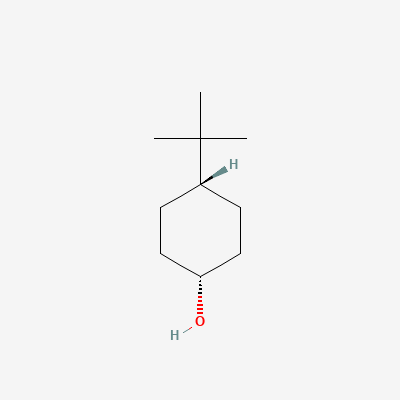
4-tert-Butylcyclohexanol
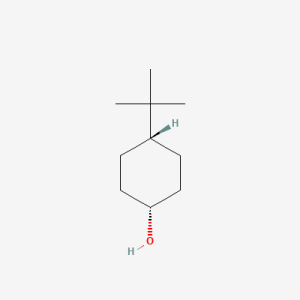
| Nazwa produktu | 4-tert-Butylcyclohexanol |
|---|---|
| Numer CAS | 21862-63-5 |
| Wygląd | White to off-white crystalline solid |
| Assay (GC) | ≥99,01 TP3T |
| Wzór cząsteczkowy | C10H20O |
| Masa cząsteczkowa | 156.27 g/mol |
| Temperatura topnienia | 70-75 °C (cis/trans mixture) |
| Boiling Point | 230-232 °C |
| Rozpuszczalność | Soluble in ethanol, isopropanol, acetone; practically insoluble in water |
| Strata przy suszeniu | ≤0.5% |
| Metale ciężkie | ≤10 ppm |
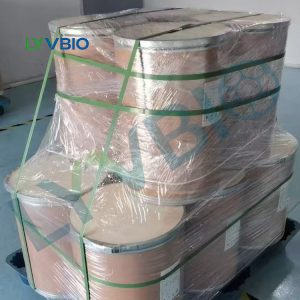
| Opakowanie | 25 kg fiber drum with PE liner, or as per request |
Potrzebujesz pomocy? Skontaktuj się z naszym zespołem
Synonimy: 4-tert-Butylcyclohexan-1-ol, 4-(1,1-Dimethylethyl)cyclohexanol, 4-t-Butylcyclohexanol, NSC 22107
4-tert-Butylcyclohexanol is a saturated cyclic alcohol featuring a cyclohexane ring substituted with a hydroxyl group and a bulky tert-butyl group. This structure gives the molecule a distinctive spatial configuration: the tert-butyl group locks the ring in a chair conformation, and the hydroxyl group can occupy either an equatorial or axial position, leading to cis- and trans-isomers with different physical properties and sensory profiles. The compound is valued in the fragrance and flavour industry for its unique woody, camphoraceous odour, often described as reminiscent of patchouli or vetiver, and it also serves as a versatile intermediate in organic synthesis.
Commercially, 4-tert-Butylcyclohexanol is produced via catalytic hydrogenation of 4-tert-butylphenol. The reaction typically employs nickel or palladium catalysts under high pressure and temperature, yielding a mixture of cis and trans isomers. Through careful control of hydrogenation conditions, manufacturers can adjust the isomer ratio to fine-tune the olfactory and physical characteristics. The product is available in technical grade (≥98%) and high-purity grade (≥99%), with the latter often preferred for fragrance applications where consistency and absence of impurities are critical.
In the personal care and household products sector, 4-tert-Butylcyclohexanol is used as a fragrance ingredient in soaps, detergents, and perfumes, where it imparts a clean, woody note and enhances the overall scent profile. It also finds application as a precursor to other fragrance compounds, such as 4-tert-butylcyclohexyl acetate, a widely used musk-like aroma chemical. Beyond its olfactory uses, the compound is employed as an intermediate in the synthesis of pharmaceuticals and agrochemicals, and as a stabiliser or additive in polymer formulations. Its low toxicity and biodegradability make it a preferred choice for environmentally conscious formulations.
4-tert-Butylcyclohexanol is a monocyclic monoterpene alcohol with the molecular formula C10H20O and a molecular weight of 156.27 g/mol. The molecule consists of a cyclohexane ring bearing a hydroxyl group and a tert-butyl group in the para position. The bulky tert-butyl substituent significantly influences the conformational dynamics of the ring, favouring the chair conformation with the tert-butyl group in an equatorial position. The hydroxyl group can be either equatorial (trans-isomer) or axial (cis-isomer), resulting in two stereoisomers that can be separated by distillation or crystallisation. The trans-isomer typically predominates in commercial products, often comprising 70-80% of the mixture. The compound is a white crystalline solid with a melting point range of 70-75 °C and a boiling point around 230-232 °C. It is soluble in most organic solvents but has limited solubility in water. Its log P of approximately 3.2 indicates moderate lipophilicity, which contributes to its substantivity on skin and fabrics.
| Parametr | Specyfikacja |
|---|---|
| Assay (GC) | ≥99,01 TP3T |
| Wygląd | White to off-white crystalline solid |
| Odour | Woody, camphoraceous |
| Temperatura topnienia | 70-75 °C |
| Strata przy suszeniu | ≤0.5% |
| Metale ciężkie | ≤10 ppm |
| Isomer Ratio (trans/cis) | 70:30 to 80:20 (typical) |
Room,5-0203, Unit 5, Beiyuanmen Street,Xi'an,Shaanxi,China
 English English
 Russian
 French
 Korean
 German
 Polish
 Japanese
 Spanish
 Italian
 Vietnamese