
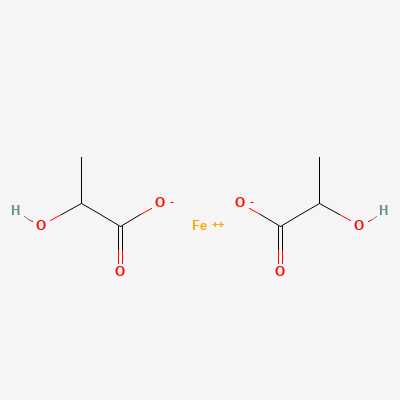
Ferrous lactate
| Nome del prodotto | Ferrous Lactate |
|---|---|
| Numero CAS | 5905-52-2 |
| Formula molecolare | C6H10FeO6 |
| Peso molecolare | 233.99 g/mol |
| Aspetto | Greenish-white to pale green crystalline powder |
| Assay (Ferrous Iron) | ≥ 20.0% (dry basis) |
| Perdita per essiccazione | ≤ 5,01 TP3T |
| Metalli pesanti | ≤ 10 ppm |
| Solubilità | Soluble in water; practically insoluble in ethanol |
| Confezione | 25 kg fiber drum with double polyethylene liner |
Hai bisogno di aiuto? Contatta il nostro team
Synonyms: Iron(II) lactate, Ferrous 2-hydroxypropanoate, Iron dilactate, Lactic acid iron(II) salt
Ferrous lactate is the iron(II) salt of lactic acid, represented by the formula C6H10FeO6. It typically occurs as a greenish-white to pale green crystalline powder with a mild, characteristic odor. Unlike many inorganic iron salts, ferrous lactate is well tolerated by the gastrointestinal tract and does not cause the metallic aftertaste or darkening of teeth associated with ferrous sulfate. It has been used for decades as a source of bioavailable iron in pharmaceutical preparations and as a food fortification ingredient, particularly in Europe and Asia.
Chemically, ferrous lactate is a coordination compound in which the ferrous ion (Fe2+) is bound to two lactate anions. The lactate ligand is a small, naturally occurring alpha-hydroxy acid that participates in human metabolism, making the salt highly biocompatible. The ferrous state is essential for absorption; the iron must remain in the +2 oxidation state to be taken up efficiently by the divalent metal transporter (DMT1) in the small intestine. This is why formulators often choose ferrous lactate over ferric salts, which require reduction before absorption. The compound is moderately soluble in water, and its solutions are slightly acidic due to the lactate moiety.
Commercial ferrous lactate is standardized to a ferrous iron content of 20% or higher, with tight control over oxidation to the ferric state. It is produced by reacting lactic acid with a ferrous source under controlled conditions to prevent oxidation. The resulting product is a free-flowing powder that blends well into dry mixes, tablets, and capsules. Its primary applications include iron-deficiency anemia treatment, prenatal and pediatric supplements, and fortified foods such as infant formula, cereals, and beverages. It is also used in veterinary medicine and as a nutrient in cell culture media.
| Parametro | Specifiche |
|---|---|
| Assay (Ferrous Iron) | ≥ 20.0% |
| Identificazione | Positive for lactate and ferrous iron |
| Perdita per essiccazione | ≤ 5,01 TP3T |
| Residuo di combustione | ≤ 0,11 TP3T |
| Metalli pesanti | ≤ 10 ppm |
| Limiti microbiologici | Conta aerobica totale ≤ 1000 UFC/g; lieviti e muffe ≤ 100 UFC/g; assenza di E. coli |
Room,5-0203, Unit 5, Beiyuanmen Street,Xi'an,Shaanxi,China
 English English
  Russian
 French
 Korean
 German
 Polish
 Japanese
 Spanish
 Italian
 Vietnamese