
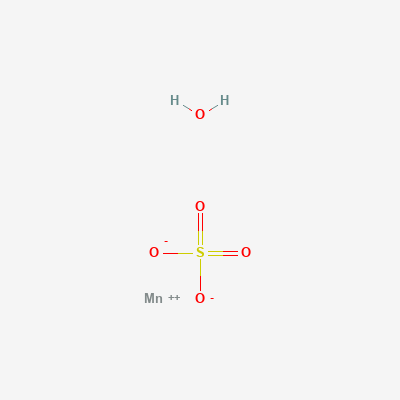
Manganese sulfate monohydrate
| Produktname | Manganese sulfate monohydrate |
|---|---|
| CAS-Nummer | 10034-96-5 |
| Molekülformel | MnSO4·H2O |
| Molekulargewicht | 169.02 g/mol (monohydrate) |
| Aussehen | Light pink to off-white crystalline powder |
| Assay (Mn) | ≥31.8% |
| Manganese (as MnSO4·H2O) | ≥98,01 TP3T |
| Löslichkeit | Soluble in water, slightly soluble in alcohol |
| Trocknungsverlust | 10.0–12.0% |
| Schwermetalle | ≤ 10 ppm |
| Verpackung | 25 kg net paper bag or fiber drum with PE liner |
Brauchst du Hilfe? Kontaktieren Sie unser Team
Synonyms: Manganese(II) sulfate monohydrate, Manganous sulfate monohydrate, Manganese sulphate monohydrate, MnSO4·H2O, Manganese monosulfate monohydrate
Manganese sulfate monohydrate is the hydrated sulfate salt of divalent manganese, with the formula MnSO4·H2O and a molecular weight of 169.02 g/mol. It typically appears as a light pink to off-white crystalline powder, a colour that reflects the presence of the Mn(II) ion in an octahedral coordination environment. The monohydrate is the most common commercial form of manganese sulfate, prized for its high water solubility and stability under normal storage conditions.
Historically, manganese sulfate has been produced both from natural ores such as pyrolusite (MnO2) and from by-product streams of various industrial processes. In agriculture, it has long been used as a micronutrient fertilizer to correct manganese deficiency in crops, particularly in alkaline or highly organic soils. In the pharmaceutical and nutraceutical sectors, it serves as a source of manganese for total parenteral nutrition (TPN) solutions and as a mineral supplement in multivitamin formulations.
From a chemical standpoint, manganese sulfate monohydrate is a mild oxidizing agent under certain conditions but generally behaves as a simple ionic salt. It is highly soluble in water (approximately 76 g/100 mL at 20°C), slightly soluble in ethanol, and insoluble in most organic solvents. Its aqueous solutions are acidic due to hydrolysis of the Mn(II) ion. The monohydrate form is preferred over the anhydrous salt in many applications because it is less hygroscopic and easier to handle, while still delivering a high manganese content of about 31.8% by weight.
In the B2B supply chain, manganese sulfate monohydrate is typically offered in technical, feed, food, and pharmaceutical grades. The pharmaceutical grade must meet stringent purity requirements, including low levels of heavy metals such as lead, arsenic, and cadmium, as well as controlled microbial limits. It is a key raw material for the production of other manganese compounds, such as potassium permanganate, and serves as a precursor in the synthesis of various manganese-based catalysts and battery materials.
| Parameter | Technische Daten |
|---|---|
| Assay (as MnSO4·H2O) | ≥98,01 TP3T |
| Manganese (Mn) | 31.8–32.5% |
| Identification | Positive for manganese and sulfate |
| Trocknungsverlust | 10.0–12.0% |
| Heavy Metals (as Pb) | ≤ 10 ppm |
| Arsen (As) | ≤3 ppm |
| Microbial Limits | Total aerobic count ≤1000 CFU/g; Yeast & Mold ≤100 CFU/g; E. coli absent |
Room,5-0203, Unit 5, Beiyuanmen Street,Xi'an,Shaanxi,China
 English English
 Russian
 French
 Korean
 German
 Polish
 Japanese
 Spanish
 Italian
 Vietnamese