
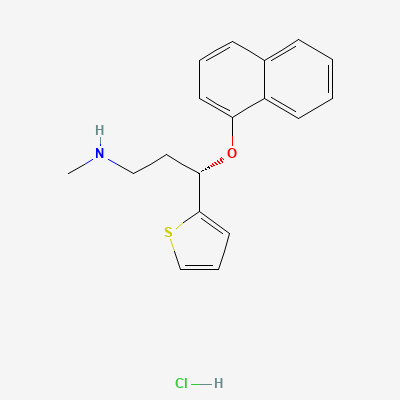
Duloxetine HCl
| Produktname | Duloxetine HCl |
|---|---|
| CAS-Nummer | 136434-34-9 |
| Molekülformel | C18H19NOS·HCl |
| Molekulargewicht | 333.88 g/mol |
| Aussehen | Weißes bis cremefarbenes kristallines Pulver |
| Analyse (HPLC) | 98.0% – 102.0% (on dried basis) |
| Trocknungsverlust | ≤ 0,5% |
| Verbrennungsrückstand | ≤ 0.1% |
| Schwermetalle | ≤ 20 ppm |
| Verpackung | 25 kg fiber drum with double polyethylene bags |
Brauchst du Hilfe? Kontaktieren Sie unser Team
Synonyme: (S)-N-Methyl-3-(1-naphthyloxy)-3-(2-thienyl)propan-1-amine hydrochloride, LY248686, Duloxetine hydrochloride, Cymbalta, Yentreve, Ariclaim, Xeristar
Duloxetine HCl is a dual serotonin and norepinephrine reuptake inhibitor (SNRI) that has become a cornerstone in the treatment of major depressive disorder, generalized anxiety disorder, and neuropathic pain. As a hydrochloride salt, it offers improved aqueous solubility and stability compared to the free base, making it the preferred form for oral solid dosage formulations. The compound was originally developed by Eli Lilly and received FDA approval in 2004 under the brand name Cymbalta.
Chemically, duloxetine HCl is a naphthalenyloxy-substituted thiophene propanamine. Its structure features a chiral center, and the active pharmaceutical ingredient is the (S)-enantiomer, which is significantly more potent than the (R)-enantiomer. The molecule’s lipophilic naphthalene and thiophene rings facilitate blood-brain barrier penetration, while the secondary amine side chain is responsible for its interaction with serotonin and norepinephrine transporters. This dual mechanism distinguishes it from selective serotonin reuptake inhibitors (SSRIs) and contributes to its broader efficacy profile.
From a manufacturing perspective, duloxetine HCl is synthesized through a multi-step process that typically starts from 1-naphthol and 2-acetylthiophene, followed by a resolution step to isolate the desired (S)-enantiomer. The final hydrochloride salt is crystallized to high purity, with particle size distribution carefully controlled to ensure consistent dissolution and bioavailability in finished dosage forms. Our material is produced under cGMP conditions and is supported by a comprehensive regulatory package, including DMF and CEP where applicable.
| Parameter | Technische Daten |
|---|---|
| Analyse (HPLC) | 98.0% – 102.0% |
| Identification | IR and HPLC retention time match reference standard |
| Trocknungsverlust | ≤ 0,5% |
| Verbrennungsrückstand | ≤ 0.1% |
| Schwermetalle | ≤ 20 ppm |
| Microbial Limits | Total aerobic count ≤ 1000 CFU/g; Yeast & mold ≤ 100 CFU/g; E. coli absent |
Room,5-0203, Unit 5, Beiyuanmen Street,Xi'an,Shaanxi,China
 English English
 Russian
 French
 Korean
 German
 Polish
 Japanese
 Spanish
 Italian
 Vietnamese