
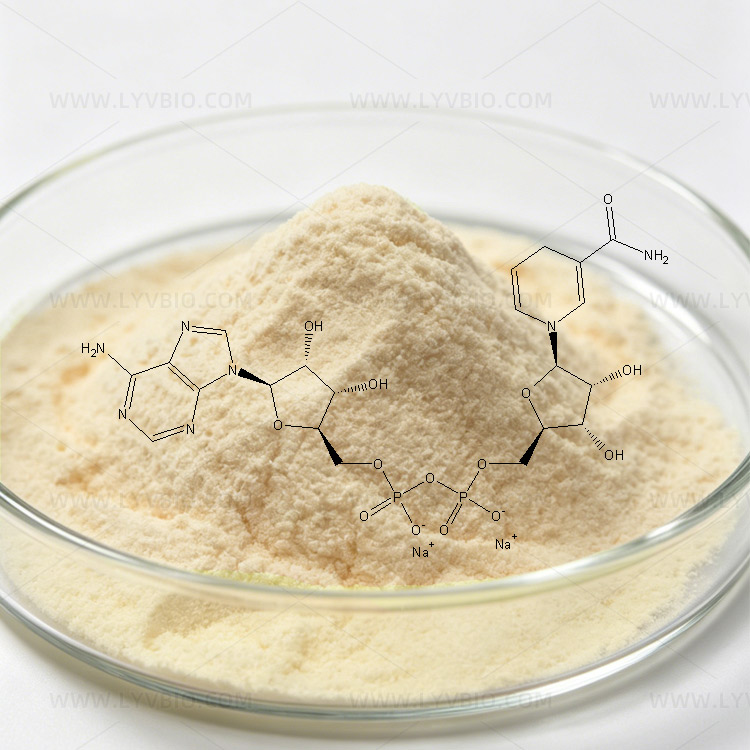
| Product Name | NADH (Reduced Nicotinamide Adenine Dinucleotide) |
| CAS Number | 606-68-8 |
| Molecular Formula | C₂₁H₂₉N₇O₁₄P₂ |
| Molecular Weight | 665.44 g/mol |
| Appearance | White to off-white lyophilized powder |
| Assay (HPLC) | ≥ 98.0% (≥ 99.0% pharmaceutical grade) |
Need help? Contact our team
NADH (Nicotinamide Adenine Dinucleotide, reduced form) is a coenzyme found naturally in every living cell. It is the reduced form of NAD⁺ (nicotinamide adenine dinucleotide) and plays an essential role in cellular energy production. NADH is the primary electron donor in the mitochondrial electron transport chain, driving ATP synthesis.
NADH is the biologically active, “energy-rich” form of NAD⁺. While NAD⁺ is the oxidized form (electron acceptor), NADH is the reduced form (electron donor). The NAD⁺/NADH ratio is a critical regulator of cellular metabolism, redox balance, and mitochondrial function.
| Other name | eta-d-ribofuranosyl-3-pyridinecarboxamide,disodiumsalt;
BETA-NICOTINAMIDEADENINEDINUCLEOTIDE,REDUCEDFORMDISODIUMSALT; BETA-NICOTINAMIDE-ADENINEDINUCLEOTIDE,REDUCED,2NA; BETA-NICOTINAMIDEADENINEDINUCLEOTIDEREDUCEDDISODIUMSALT; BETA-NICOTINAMIDEADENINEDINUCLEOTIDE,DISODIUMSALT; beta-Nicotinamideadeninedinucleotidedisodiumsalthydrate; eta-d-ribofuranosyl-3-pyridinecarboxamide,disodiumsaltbeta-nicotinamideadeninedinucleotide,disodiumsalt,hydratebeta-nicotinamideadeninedinucleotidedisodiumsalt,trihydrate; NICOTINAMIDEADENINEDINUCLEOTIDE(REDUCED)DISODIUMSALTextrapure |
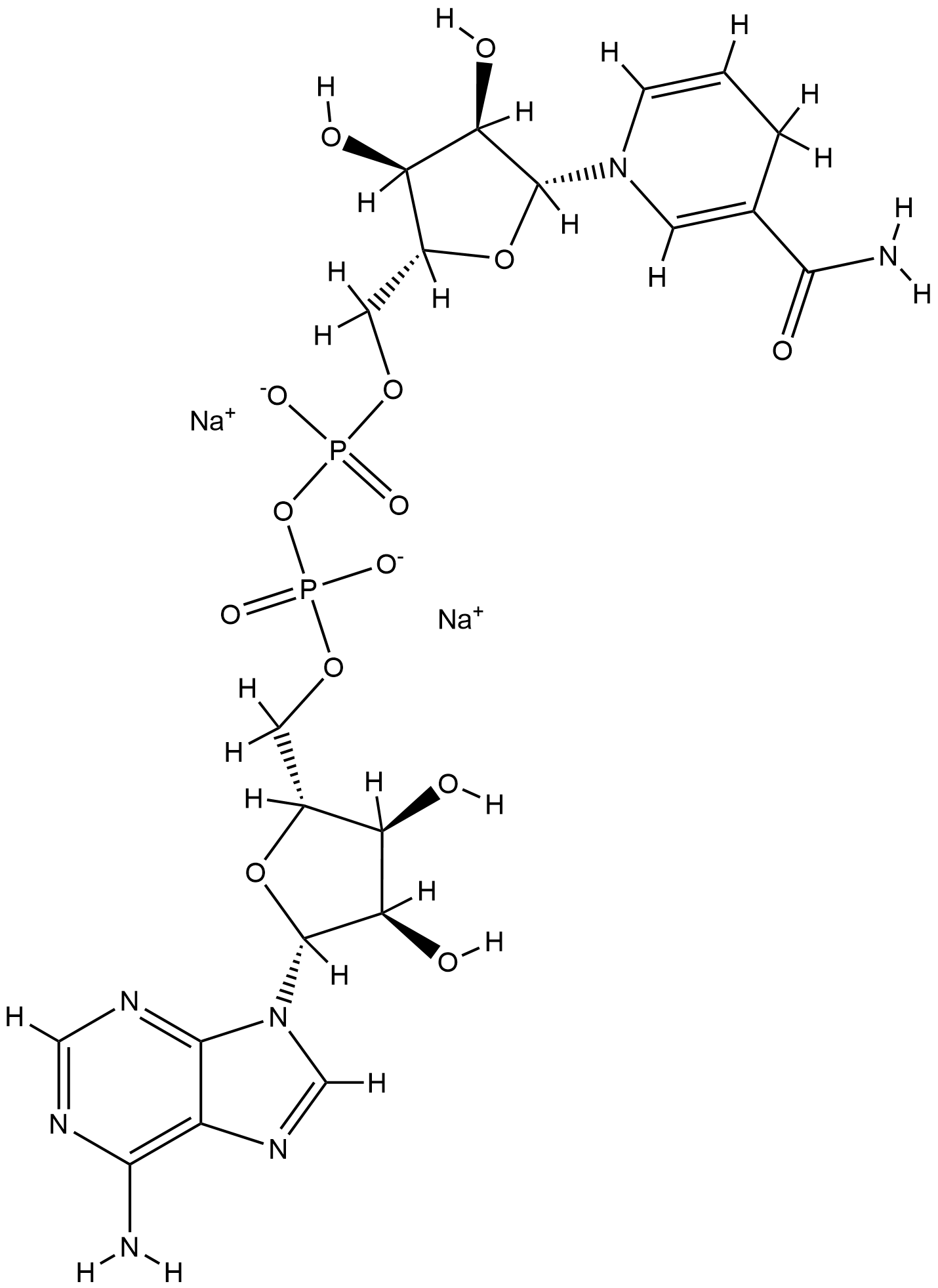
BETA-NICOTINAMIDE ADENINE DINUCLEOTIDE, REDUCED FORM DISODIUM SALT
MF:C21H27N7Na2O14P2
The NAD⁺/NADH Cycle:
| Form | Oxidation State | Primary Role |
|---|---|---|
| NAD⁺ | Oxidized (electron acceptor) | Substrate for sirtuins, PARPs, CD38 |
| NADH | Reduced (electron donor) | Electron carrier for ATP production |
| NAD⁺/NADH ratio | Metabolic health indicator | Determines redox balance |
NADH is the body’s most abundant energy carrier. Each NADH molecule generates approximately 2.5 ATP molecules in the mitochondria. Without NADH, cellular energy production would cease within seconds.
NADH is extremely sensitive to heat, light, oxygen, and moisture. Degradation converts NADH to NAD⁺ (inactive for energy production) and other breakdown products. Proper storage (-20°C freezer, sealed, desiccated, protected from light) is essential. LyvBio ships NADH in temperature-controlled packaging with desiccant.
(1) High purity: NADH can obtain high-purity products through a refined production process. High purity means better bioavailability and fewer adverse reactions.
(2) Antioxidant properties: NADH has powerful antioxidant properties and can protect cells from damage caused by oxidative stress and free radicals.
(3) Stability: NADH has good stability and can maintain its activity and effect under different environments and storage conditions.
BETA-NICOTINAMIDE ADENINE DINUCLEOTIDE, REDUCED FORM DISODIUM SALT
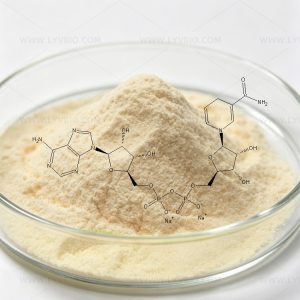
NADH, disodium salt
LyvBio Co., Ltd. is a GMP-certified supplier of high-purity NADH for the nutraceutical, sports nutrition, and healthy aging industries.
Supply capabilities:
Assay (HPLC): ≥98.0% (standard), ≥99.0% (pharmaceutical grade)
NAD⁺ content: ≤2.0%
Form: Lyophilized powder (standard); stabilized encapsulated (custom)
Monthly capacity: 10+ kg
Bulk quantities: 1g – 10kg
Lead time: 3–5 days (samples), 10–15 days (bulk)
Documentation: COA, MSDS, TDS, HPLC chromatogram, NAD⁺/NADH ratio analysis, stability data
| Parameter | Standard Grade | Test Method |
|---|---|---|
| Assay (HPLC) | ≥ 98.0% | HPLC |
| NAD⁺ content | ≤ 2.0% | HPLC |
| Appearance | White to off-yellow powder | Visual |
| Identification | HPLC | HPLC |
| pH (1% solution) | 7.0–9.0 | USP <791> |
| Loss on Drying | ≤ 5.0% | USP <731> |
| Purity by Enzymatic Assay | ≥ 95% | Enzymatic (NADH/NAD⁺ ratio) |
| Heavy Metals | ≤ 10 ppm | ICP-MS |
| Residual Solvents | Meet USP <467> | GC |
| Microbial | TPC ≤ 100 cfu/g | USP <61> |
Q: What is the difference between NADH and NAD⁺?
A: NADH is the reduced form (electron donor, “energy-rich”). NAD⁺ is the oxidized form (electron acceptor, substrate for sirtuins/PARPs). NADH drives ATP production; NAD⁺ supports longevity pathways. They are chemically distinct with different CAS numbers: NADH (606-68-8), NAD⁺ (53-84-9).
Q: Is NADH stable for oral supplementation?
A: Standard NADH is extremely unstable (degrades rapidly in heat, light, moisture, oxygen). LyvBio offers stabilized NADH (enteric-coated or complexed) specifically for oral finished products. Stabilized NADH has significantly improved shelf life (12–24 months at room temperature).
Q: What is the difference between NADH and NMN/NR?
A: NADH is the active energy carrier (provides electrons for ATP). NMN and NR are NAD⁺ precursors (raw material for NAD⁺ synthesis). NADH is for acute energy/cognitive support; NMN/NR are for long-term NAD⁺ restoration (healthy aging).
Q: What is the recommended dosage for finished products?
A: General energy: 5–10 mg/day. Chronic fatigue: 10–30 mg/day. Cognitive focus: 5–20 mg as needed. Athletic performance: 10–20 mg pre-workout.
Q: Why does NADH need to be stored at -20°C?
A: NADH is extremely sensitive to heat, moisture, oxygen, and light. At room temperature, un-stabilized NADH degrades significantly within weeks. At -20°C (freezer), it remains stable for 12 months. Stabilized NADH formulations have better room-temperature stability.
Q: Is NADH vegan?
A: Yes. NADH is produced by fermentation or enzymatic synthesis, not from animal sources. LyvBio NADH is 100% vegan.
Q: What is your MOQ?
A: Sample orders: 10g–20g. Trial production: 50g–500g. Commercial: Negotiable (1kg+ receives volume pricing). Lead time: 3–5 days (samples); 10–15 days (bulk). All NADH shipments are temperature-controlled (dry ice or gel packs).
Ready to formulate with the body’s most essential energy carrier?
📧 Email: info@lyvbio.com
🌐 Website: https://www.lyvbio.com
 English English
  Russian
 French
 Korean
 German
 Polish
 Japanese
 Spanish
 Italian
 Vietnamese