
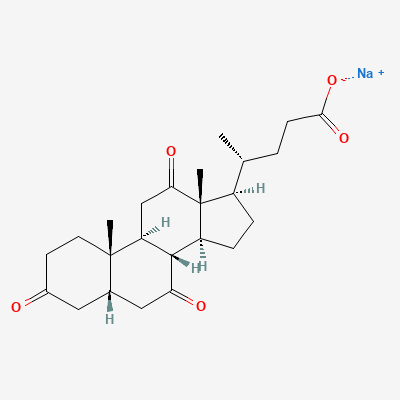
Sodium Dehydrocholate
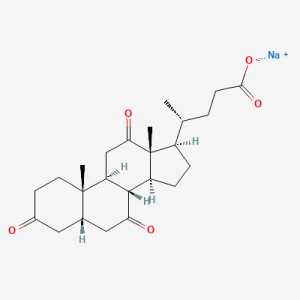
| Product Name | Sodium Dehydrocholate |
|---|---|
| CAS Number | 145-41-5 |
| Other Names | Dehydrocholic acid sodium salt; Sodium 3,7,12-trioxo-5β-cholan-24-oate; DHCA sodium salt |
| Molecular Formula | C24H33O5Na |
| Molecular Weight | 424.51 g/mol |
| Appearance | White to off-white crystalline powder |
| Assay (HPLC) | ≥98.0% |
| Solubility | Soluble in water and ethanol; practically insoluble in non-polar solvents |
| Loss on Drying | ≤5.0% |
| Heavy Metals | ≤20 ppm |
| Package | 25 kg net in fiber drum with double polyethylene liner |
Need help? Contact our team
Synonyms: Dehydrocholic acid sodium salt; Sodium 3,7,12-trioxo-5β-cholan-24-oate; DHCA sodium salt; 3,7,12-Trioxo-5β-cholan-24-oic acid sodium salt; Sodium dehydrocholate
Sodium dehydrocholate is the sodium salt of dehydrocholic acid, a synthetic bile acid derivative that has been chemically modified to carry three ketone groups at the 3, 7, and 12 positions of the steroid nucleus. Unlike the naturally occurring bile acids such as cholic acid or chenodeoxycholic acid, which bear hydroxyl groups at these positions, the oxidation to ketones gives dehydrocholic acid a distinctly different physicochemical profile. This structural change eliminates the hydrogen-bonding capacity of the hydroxyls and increases the molecule’s planar character, which in turn affects its aggregation behavior in aqueous solution. The sodium salt form is freely water-soluble, making it particularly convenient for pharmaceutical formulation and biochemical research.
Historically, dehydrocholic acid was introduced as a choleretic agent—a substance that stimulates the flow of bile without significantly altering its composition. It was used in clinical practice to promote bile secretion in patients with biliary stasis or post-cholecystectomy. While newer agents have largely replaced it in human medicine, the compound remains relevant as a pharmaceutical intermediate and as a reference standard in bile acid analysis. Its sodium salt is often chosen when aqueous solubility is required, such as in injectable solutions or in vitro assays.
From a chemical standpoint, sodium dehydrocholate is a C24 steroid with a carboxylate group at the side chain. The three ketones at C3, C7, and C12 are the defining feature, and they render the molecule more polar than its hydroxylated counterparts. This polarity influences its chromatographic behavior and its interaction with proteins and membranes. In the laboratory, it is used as a model compound to study bile acid transport, micelle formation, and the effects of bile acids on enzyme activity. Its sodium salt is also employed as a choleretic standard in analytical methods.
For B2B buyers, sodium dehydrocholate is typically sourced as a high-purity chemical for further manufacturing or research. It is not a botanical extract but a well-characterized synthetic compound, and specifications focus on assay, solubility, and residual solvents. The material is generally produced via oxidation of cholic acid followed by neutralization with sodium hydroxide. Quality control includes HPLC assay, water content, and heavy metal limits. Because it is a fine chemical, batch-to-batch consistency is critical for downstream applications.
| Parameter | Specification |
|---|---|
| Assay (HPLC) | ≥98.0% |
| Identification | IR and HPLC retention time match reference standard |
| Loss on Drying | ≤5.0% |
| Heavy Metals | ≤20 ppm |
| Residue on Ignition | ≤0.5% |
| Microbial Limits | Total aerobic count ≤1000 CFU/g; Yeast & Mold ≤100 CFU/g; E. coli absent |
Room,5-0203, Unit 5, Beiyuanmen Street,Xi'an,Shaanxi,China
 English English
 Russian
 French
 Korean
 German
 Polish
 Japanese
 Spanish
 Italian
 Vietnamese